
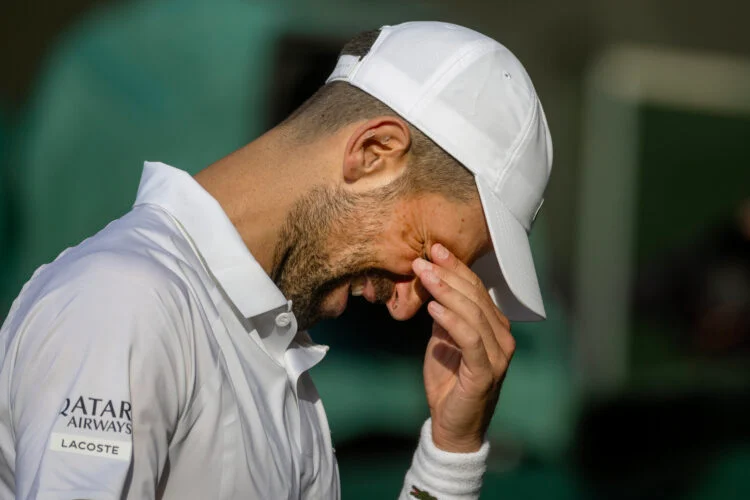
A Thriller Overshadowed by Off-Court Chaos
Novak Djokovic’s breathtaking, five-set quarter-final victory over Felix Auger-Aliassime will go down as one of the most dramatic encounters of the 2026 championships. For over five grueling hours, both men traded heavy blows from the baseline, treating the Centre Court crowd to an absolute masterclass. Yet, what should have been a celebration of pure sporting theatre was severely marred by a bizarre, mid-match intervention from the All England Club. Midway through the contest, tournament officials chose to disrupt the rhythm of a high-stakes Grand Slam match with a decision that left Djokovic furious—and entirely justified in his outrage.
The Core of the Controversy
The flashpoint occurred right after Auger-Aliassime clinched the second set 6-3 to level the match at one set apiece. At exactly 7:40 p.m., under perfectly fine weather conditions, tournament referee Denise Parnell stepped onto Center Court to deliver an unexpected bombshell: play was to be temporarily suspended so that the retractable roof could be closed. The decision came as a shock to everyone in the stadium. Wimbledon officials claimed the premature shutdown was a preemptive strike against fading light, eager to avoid a mid-set suspension later in the evening. However, the logic collapsed under the slightest bit of scrutiny.
Djokovic Demands Accountability
Djokovic, a veteran of SW19 who knows the natural rhythms of the tournament better than almost anyone, did not hold back. He immediately summoned the tournament supervisor to the court, demanding a logical explanation for the interruption. “The other day you didn’t want to close it until 8:20, 8:30, and now you want to close it? It’s 7:40 now. We can play a whole another set outdoors. We are an outdoor tournament,” Djokovic barked. When the supervisor attempted to cite a previous match involving Jannik Sinner to justify the decision, the 24-time Grand Slam champion dismissed the comparison out of hand, reiterating that the officials lacked any semblance of consistency.
A Shambolic Disregard for Grand Slam Conditions
Djokovic’s anger was not just a case of elite-athlete petulance; he was highlighting a fundamental flaw in the tournament’s modern management. Wimbledon prides itself on being the ultimate outdoor grass-court test. Forcing a match indoor changes the entire playing environment, altering ball bounce, humidity, and air resistance. Felix Auger-Aliassime, who notoriously thrives in indoor environments, essentially received an unintended tactical lifeline. While the Canadian player briefly echoed Djokovic’s desire to stay outdoors, he could scarcely believe his luck as the conditions shifted completely in his favor, dragging the match into a five-hour marathon.
The Need for Clear Rules Moving Forward
Wimbledon’s handling of the situation has rightly been condemned as shambolic by commentators and fans alike. By acting unpredictably, the tournament actively interferes with the competitive integrity of the sport. If the grass-court Major wants to retain its prestigious reputation, it must establish a transparent, unyielding policy for roof closures rather than relying on arbitrary, panic-induced scheduling decisions. Djokovic eventually triumphed in a final-set tiebreak, but he should never have been forced to battle both his opponent and the tournament’s own logistical incompetence.