
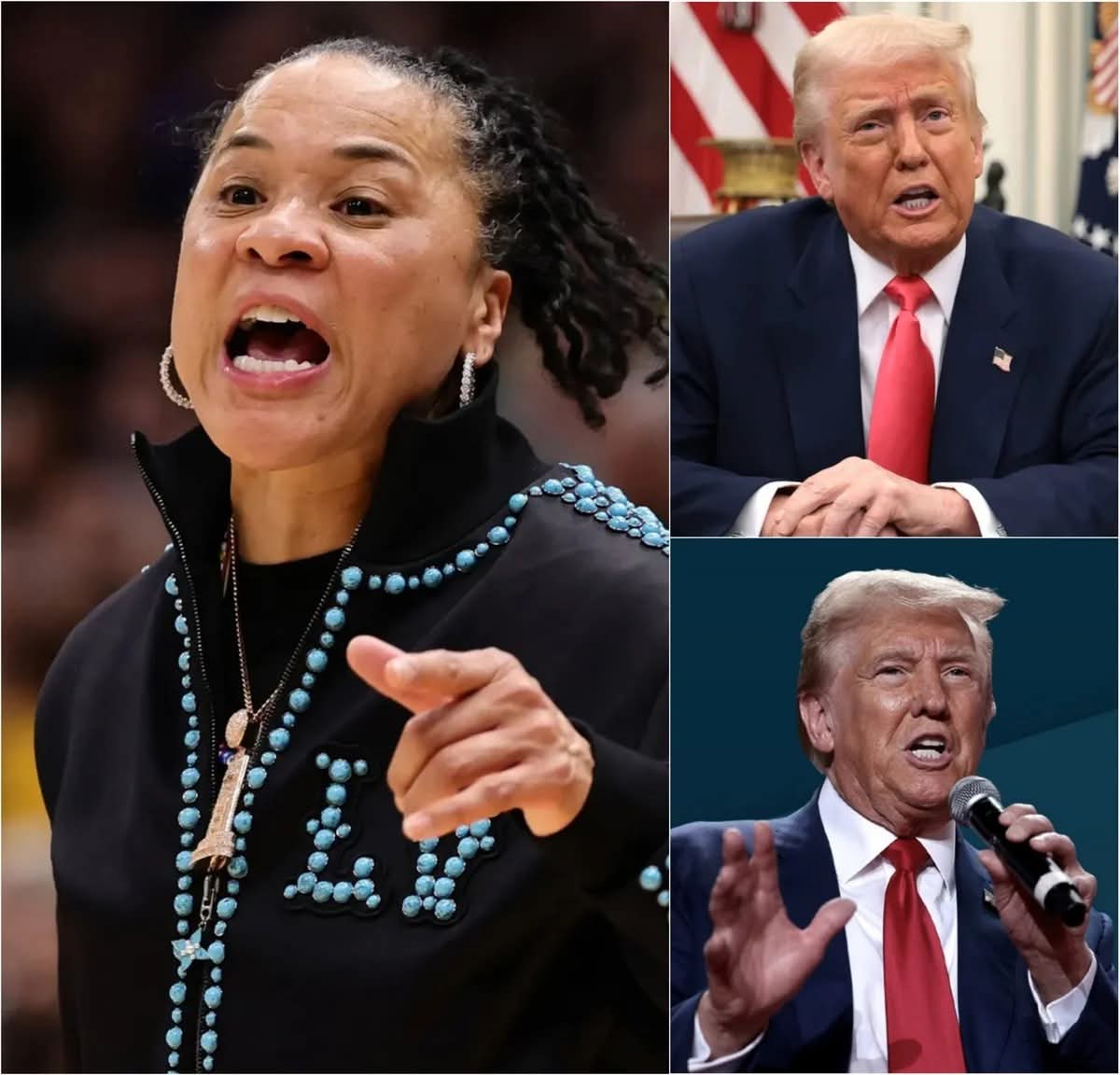
In a political landscape increasingly defined by personal attacks and religious gatekeeping, a new front has opened between President Donald Trump and one of the most respected figures in American sports. During a recent campaign stop, Trump leveled sharp criticism at South Carolina women’s basketball coach Dawn Staley, labeling her “an insult to Jesus” and accusing her of being “beyond woke.” However, the Hall of Famer’s response—delivered with measured, surgical precision—has transformed a standard political jab into a profound national conversation on faith and accountability.
The Spark of Controversy
The friction began when Trump targeted Staley’s public stance on social issues and her leadership style, suggesting that her advocacy challenged traditional religious values. These comments were widely seen as an attempt to consolidate support among conservative voters by framing Staley as a symbol of radical progressivism. For a coach known for her discipline and deep-rooted community ties, the accusation of being a religious insult was met with immediate and intense public scrutiny.
A Moral Counter-Indictment
Choosing a historic venue to address the claims, Staley did not descend into the arena of schoolyard insults. Instead, she offered a point-by-point moral reflection that challenged the former President’s own record. Staley redirected the definition of “insulting Jesus” toward systemic issues, citing the removal of healthcare from the vulnerable and the implementation of tax cuts for the wealthy as true affronts to Christian teachings. Her calm demeanor served as a stark contrast to the inflammatory rhetoric that sparked the exchange.
Redefining Christian Responsibility
As the address continued, Staley touched on sensitive humanitarian issues, including the separation of families at the border and the human cost of global conflicts. By invoking the biblical mandate to “love our neighbor,” she effectively turned the table on her accusers. She admitted to being an imperfect Christian while noting that true faith is measured by how one treats the least among us. This shift from political defense to moral inquiry appeared to stun the room, moving the discourse away from partisan talking points and toward human responsibility.
The Echo of a Quiet Response
The fallout from the exchange suggests that Staley’s refusal to engage in fear-based rhetoric has resonated far beyond the sports world. While Trump’s base remains loyal to his “anti-woke” messaging, many observers have lauded Staley for her clarity and conviction. Her response serves as a reminder that moral authority is often found in the quietest voices. As the 2026 political cycle heats up, this moment stands as a testament to the power of a principled rebuttal in the face of direct character attacks.