
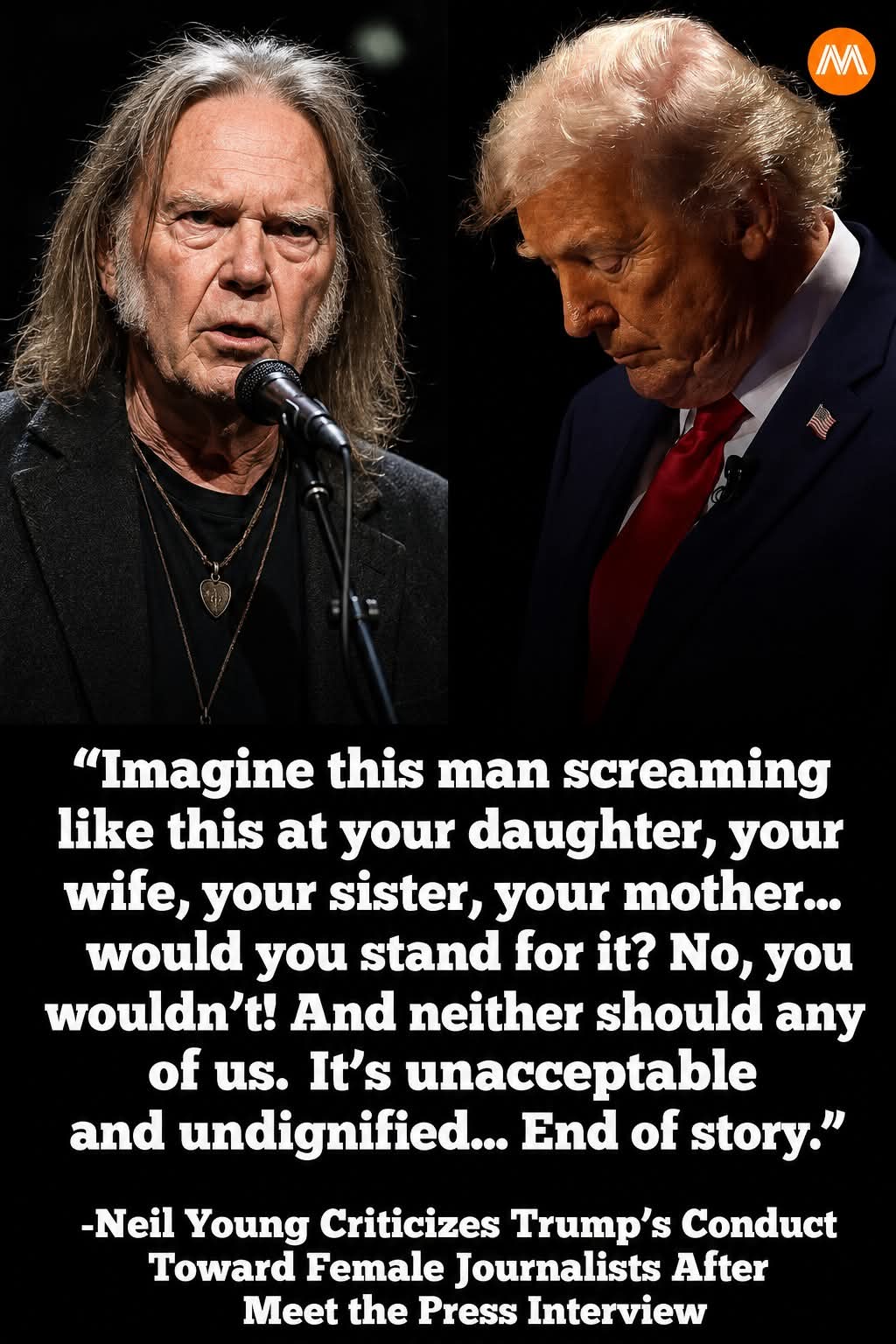
The landscape of American political discourse has exploded into a massive cultural firestorm following a blistering, highly public critique from rock legend and veteran social activist Neil Young. Stepping squarely into the national spotlight, the 80-year-old Rock and Roll Hall of Fame inductee has unleashed a scathing rebuke of President Donald Trump’s increasingly hostile treatment of female journalists. The unexpected broadside from the legendary singer-songwriter has rapidly transformed into one of the most polarizing and heavily discussed media ethics debates of the year, splitting the public into fiercely opposing ideological camps.
Young’s sharp commentary was directly triggered by a dramatic, high-stakes television event that occurred in early June 2026. During a highly contentious sit-down interview on NBC’s *Meet the Press*, recorded in Wisconsin, Trump grew visibly frustrated when veteran anchor Kristen Welker repeatedly pressed him to provide concrete evidence supporting his claims regarding election irregularities and California primary procedures. Rather than navigating the professional cross-examination, the president launched into a personal attack, labeling Welker and the network “crooked” and “stupid” before abruptly taking off his microphone and walking out of the interview entirely.
A Pattern of Personal Attacks Under Scrutiny
For Young, the intense exchange on *Meet the Press* was not an isolated incident of administrative frustration, but rather the latest marker in a deeply disturbing, recurring behavioral pattern. In his widely circulated response, the iconic protest singer explicitly referenced a prior Oval Office press briefing involving CNN Chief White House Correspondent Kaitlan Collins. When Collins aggressively questioned the president regarding the public release of files related to the Jeffrey Epstein investigation, Trump deflected from the serious inquiry by launching into a highly personal, condescending critique of the journalist’s physical demeanor.
“You know, she’s a young woman… I don’t think I’ve ever seen you smile,” Trump remarked directly to Collins in front of a crowded room of administration officials and media representatives, further claiming he saw “hatred” in her eyes. Young fiercely argued that such dismissive, patronizing tactics are deliberately employed to undermine the professional authority of women working in high-pressure political spaces. The rock icon emphasized that reduce an accomplished investigative reporter’s rigorous policy questions down to comments about her facial expressions constitutes a direct, calculated attack on the integrity of the free press.
Journalism’s Essential Role in Demanding Accountability
The core of Young’s message addresses the foundational purpose of constitutional journalism, cutting through the noise of calculated political campaign strategies. The “Heart of Gold” singer passionately asserted that the relationship between elected officials and the press corps is fundamentally designed to be adversarial and rigorous. Journalists are not stationed in the White House to provide comfortable, stage-managed public relations platforms for those who hold immense institutional power; their democratic mandate is to ask the hard questions, expose structural corruption, and demand absolute accountability for the American electorate.
Supporters of the veteran musician have quickly flooded digital spaces to praise his willingness to use his global platform to protect the press, arguing that his defense of female reporters is incredibly overdue. Conversely, staunch defenders of the administration argue that Trump has every right to aggressively fire back against what they perceive as inherently biased, partisan media coverage. They contend that his blunt, unvarnished communication style is exactly what his base demands when confronting established corporate media networks.
The Enduring Fight for Press Freedom
As the digital debate continues to rage across social media platforms, the fallout from Young’s intervention serves as a stark reminder of the deep-seated tensions defining modern political reporting. By framing the issue around systemic respect and democratic accountability rather than simple partisan politics, Young has successfully injected a powerful new voice into an ongoing battle that shows absolutely no signs of slowing down. As the 2026 political calendar intensifies, the standard for how public officials interact with the Fourth Estate remains a critical battleground for the future of American democracy.