
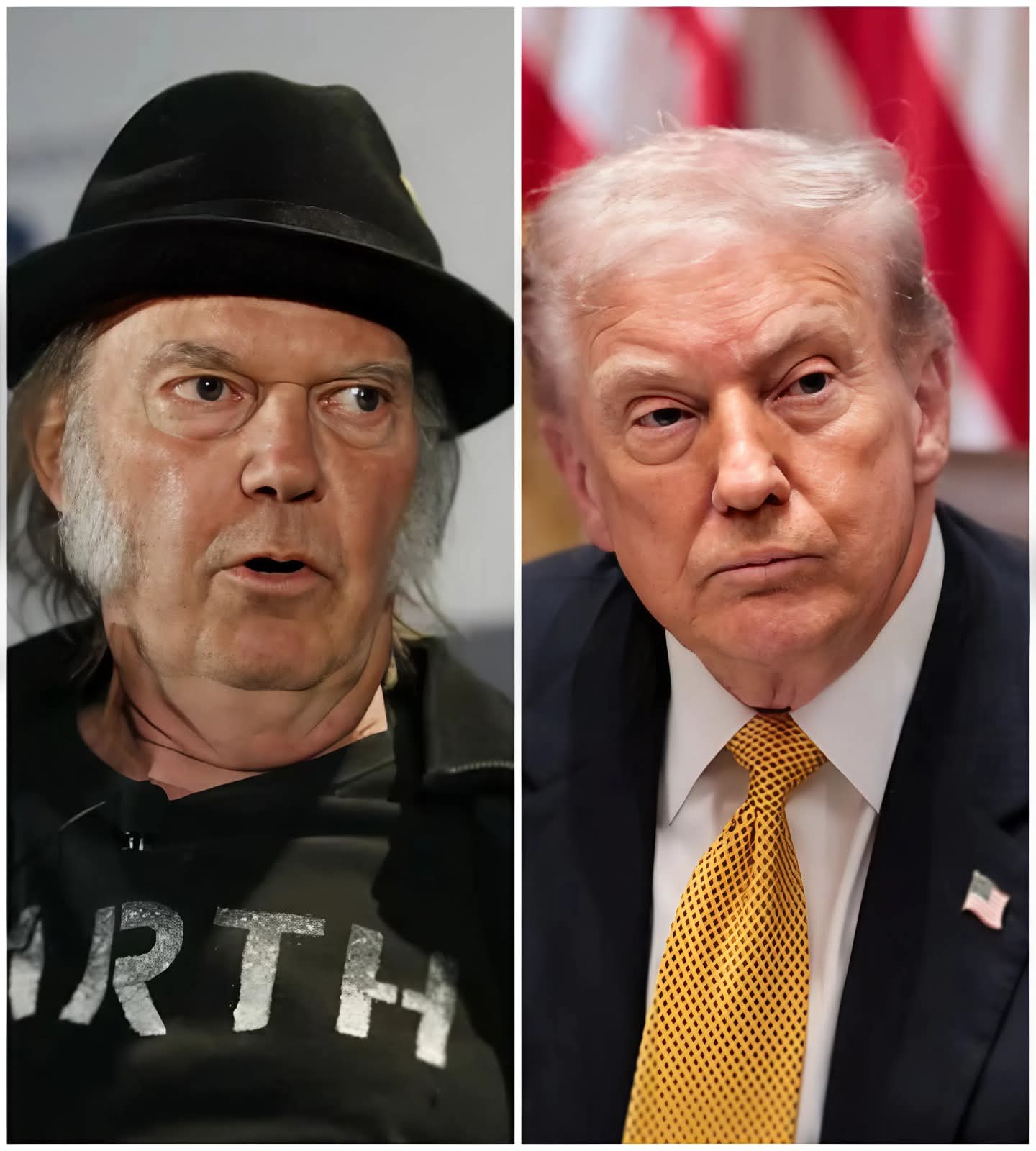
The intersection of rock history and contemporary American politics has erupted into a massive cultural debate following a high-profile verbal warfare between Donald Trump and legendary singer-songwriter Neil Young. During a recent political rally, the former president targeted the iconic musician, labeling him “an insult to Jesus” and accusing him of being “beyond woke” due to his progressive activism and traditional values defense. Rather than ignuting a standard partisan shouting match, the targeted insult prompted a calm, deeply strategic response from the 80-year-old rock icon that has rapidly captured global attention.
Addressing the controversy directly from the stage of a historic music venue, Young bypassed standard defensive platitudes to launch a methodical, emotionally charged counter-narrative. Armed with the weathered intensity that has defined his career since his days with Buffalo Springfield and Crosby, Stills, Nash & Young, the veteran activist turned the political attack into a broader philosophical critique regarding the application of faith, policy, and institutional morality in modern society.
Redefining Insults: The Musician’s Counter-Attack
“The former president just said that I insult Jesus,” Young stated to a hushed crowd, shifting the framework of the argument from personal theology to legislative accountability. “You want to know what really insults Jesus? Taking healthcare away from the sick while cutting taxes for billionaires.” The legendary protest singer, who has spent decades using his platform to champion environmentalism, farm workers, and anti-war movements, refused to let the political slogan dictate the terms of his character.
Expanding his thesis beyond financial equity, Young systematically linked religious tenets to pressing socio-political crises, including immigration reform, global conflict, and systemic poverty. He fiercely argued that separating migrant children from families, perpetuating endless foreign military conflicts, and neglecting vulnerable communities while shielding corporate power structures constitute the true betrayals of spiritual teachings. “Hiding the truth and then pretending morality is only about words,” Young asserted, directly challenging the authenticity of modern political rhetoric.
A Quiet Moment of Complete Moral Clarity
The apex of the evening materialized when the Rock and Roll Hall of Famer addressed his personal relationship with religion, offering a rare, vulnerable perspective on faith under public scrutiny. “I am not a perfect Christian,” Young murmured softly into the microphone, commanding absolute silence from the arena. “There was only one perfect Christian, and he was crucified on a cross two thousand years ago.”
Invoking the fundamental biblical commandment to love one’s neighbor as oneself, Young challenged the audience and the broader public to examine the disconnect between declared spiritual values and societal realities. He questioned how a society can tolerate systemic bigotry, structural hunger, and devastating warfare while simultaneously claiming to uphold a holy mandate. By replacing anger with unwavering conviction, Young’s articulate response has transcended typical internet controversy, serving as a powerful, enduring reminder that core human truths cannot be easily dismissed by calculated campaign slogans.