
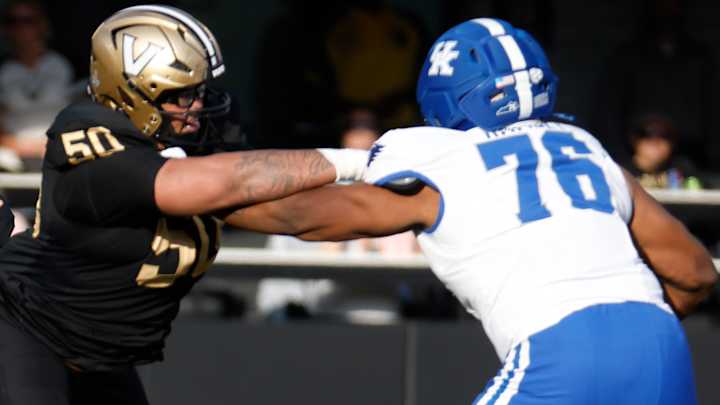
Kentucky’s offseason transformation has officially begun, and the transfer portal continues to reshape the Wildcats’ roster before the new era even reaches the field. Defensive lineman Austin Ramsey, a towering 6-foot-4, 303-pound presence, announced his decision to enter the portal, becoming the latest departure during a period of significant roster churn in Lexington.
Ramsey’s exit marks the fourth confirmed transfer since Will Stein assumed control of the program. He joins edge rushers Landyn Watson and Steven Soles Jr., along with quarterback Stone Saunders, in seeking opportunities elsewhere. While coaching transitions often spark movement, the pace of departures has underscored just how fluid Kentucky’s roster situation has become heading into the next chapter.
A native of Pennsylvania, Ramsey arrived at Kentucky with plenty of intrigue. He was rated as a three-star recruit and carried a versatile profile that turned heads during the recruiting process. ESPN ranked him as the No. 46 offensive tackle in the nation, highlighting his combination of size, athletic feet, and long-term potential on the offensive line. At the high school level, Ramsey showed the tools to develop into a reliable edge protector, a premium position in college football.
However, once he arrived in Lexington, the coaching staff under Mark Stoops charted a different path for his development. Instead of remaining on offense, Ramsey was shifted to the defensive line—a move that, while logical on paper, comes with considerable challenges. The transition from offensive tackle to defensive lineman is not simply a matter of lining up on the opposite side of the ball. It demands a complete mental reset, different hand usage, altered footwork, and a new understanding of leverage and timing.
While Ramsey possessed the physical traits to survive on either side of the line of scrimmage, the switch never fully translated into consistent on-field production during games. Practice flashes and raw strength did not consistently carry over to Saturdays, where defensive linemen must react instinctively rather than anticipate. For players accustomed to protecting the quarterback, learning to attack gaps and shed blocks can take years—time that is not always available in a results-driven college football environment.
Ramsey’s situation has also become a point of reflection for Kentucky fans evaluating the broader trajectory of the Mark Stoops era. Stoops built his reputation on physical line play and developmental patience, but not every experiment produced the desired payoff. Position changes, while often necessary for roster balance, carry inherent risk, and Ramsey’s career arc serves as an example of how those gambles can fall short.
Now, with Will Stein overseeing the program, Kentucky appears poised for a recalibration. The departures signal an effort to reshape the roster to better align with the new staff’s vision, even if it means absorbing short-term losses along the defensive front. For Ramsey, the portal offers a fresh start—potentially at a program willing to revisit his original offensive line projection or provide a clearer developmental path on defense.
As the transfer window remains active, Ramsey’s exit may not be the last. Kentucky’s offseason storyline is quickly becoming one of transition, evaluation, and redefinition. The Wildcats are turning the page, and the roster purge suggests the next phase is already underway, even before the first snap of the Will Stein era is taken.