
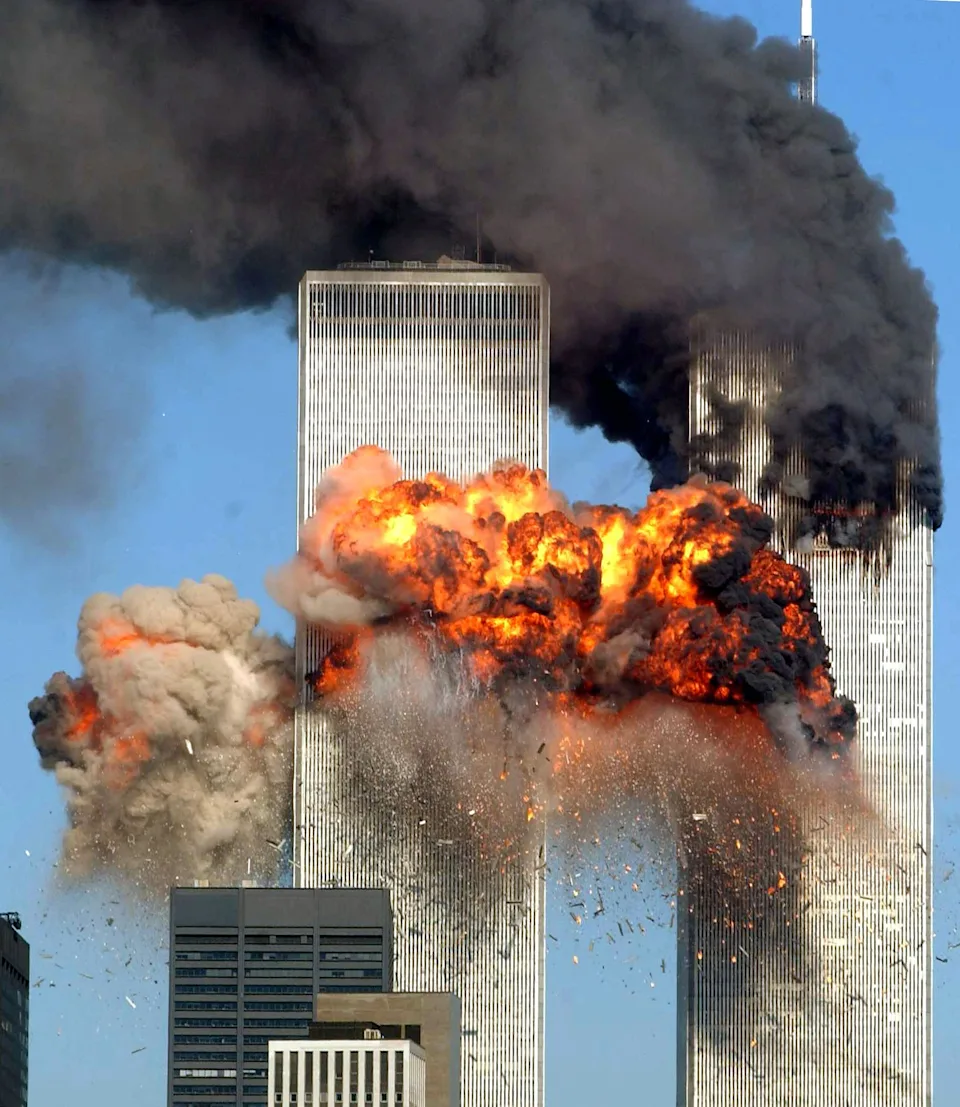
WASHINGTON — President Donald Trump has, on multiple occasions over the years, asserted that he foresaw the September 11, 2001 attacks on the World Trade Center, claiming that his warnings about Osama bin Laden went unheeded and that the tragedy might have been avoided if officials had listened to him. The claims, however, have been repeatedly challenged by historians, fact-checkers, and reviews of the public record.
Trump’s assertions date back more than a decade and have resurfaced periodically during interviews, campaign events, and informal remarks to reporters. Most recently, he reiterated the claim while speaking aboard Air Force One, telling reporters that he warned about bin Laden in his 2000 book, The America We Deserve, and suggested that decisive action at the time could have prevented the attacks that killed nearly 3,000 people.
“You had to go after bin Laden,” Trump said, describing himself as an early voice sounding the alarm. “If they would have listened, you wouldn’t have had the World Trade Center tragedy.”
What the Record Shows
Independent reviews of The America We Deserve, published in January 2000, show that the book contains a brief reference to bin Laden but does not predict the September 11 attacks or call for a preemptive strike against him. At the time, bin Laden was already a known figure to U.S. intelligence agencies, following the 1998 bombings of American embassies in Kenya and Tanzania.
Fact-checking organizations have consistently concluded that Trump’s claim overstates both the substance and significance of the reference in the book. While bin Laden is mentioned, experts say the passage does not amount to a warning of an imminent attack on U.S. soil, nor does it outline a strategy to stop one.
Former U.S. officials have also noted that intelligence warnings about al-Qaeda were widespread in the late 1990s and early 2000s, coming from multiple agencies and analysts. Trump, who held no government position at the time, was not part of official counterterrorism discussions or briefings.
A Recurrent Narrative
Despite repeated debunking, Trump has continued to revisit the claim, often framing it as evidence of his instincts on national security. During his 2016 presidential campaign, he made similar statements, portraying himself as someone who recognized the threat earlier than political leaders in Washington.
Political analysts say the persistence of the claim reflects a broader pattern in Trump’s public rhetoric, in which he casts himself as uniquely perceptive and wronged by institutions that failed to follow his guidance. “It reinforces a narrative of personal foresight and grievance,” said one political historian. “But it does not align with documented facts.”
Reaction and Criticism
Critics argue that invoking 9/11 in this way risks distorting a deeply traumatic event for political or personal validation. Families of victims and advocacy groups have emphasized the importance of accuracy and sensitivity when discussing the attacks, warning against retroactive claims that cannot be substantiated.
Supporters, meanwhile, often view Trump’s remarks as an expression of his long-held views on terrorism rather than a literal prediction. Still, even sympathetic commentators acknowledge that the claim lacks documentary support.
Why It Matters
The debate over Trump’s statements highlights a broader issue of historical accuracy in political discourse. As a sitting president, Trump’s words carry significant weight, and repeated assertions—regardless of their factual basis—can shape public perception over time.
Experts warn that blurring the line between hindsight and prediction can undermine trust in verified historical records. “When leaders repeatedly make claims that contradict established facts, it becomes harder for the public to distinguish evidence from narrative,” said a media ethics researcher.
Conclusion
While Donald Trump continues to insist that he predicted the Twin Towers attacks, extensive fact-checking and historical analysis show no evidence that he foresaw 9/11 in any meaningful or actionable way. The claim remains one of several disputed assertions in Trump’s long public record, illustrating the enduring tension between personal narrative and documented history in modern American politics.