
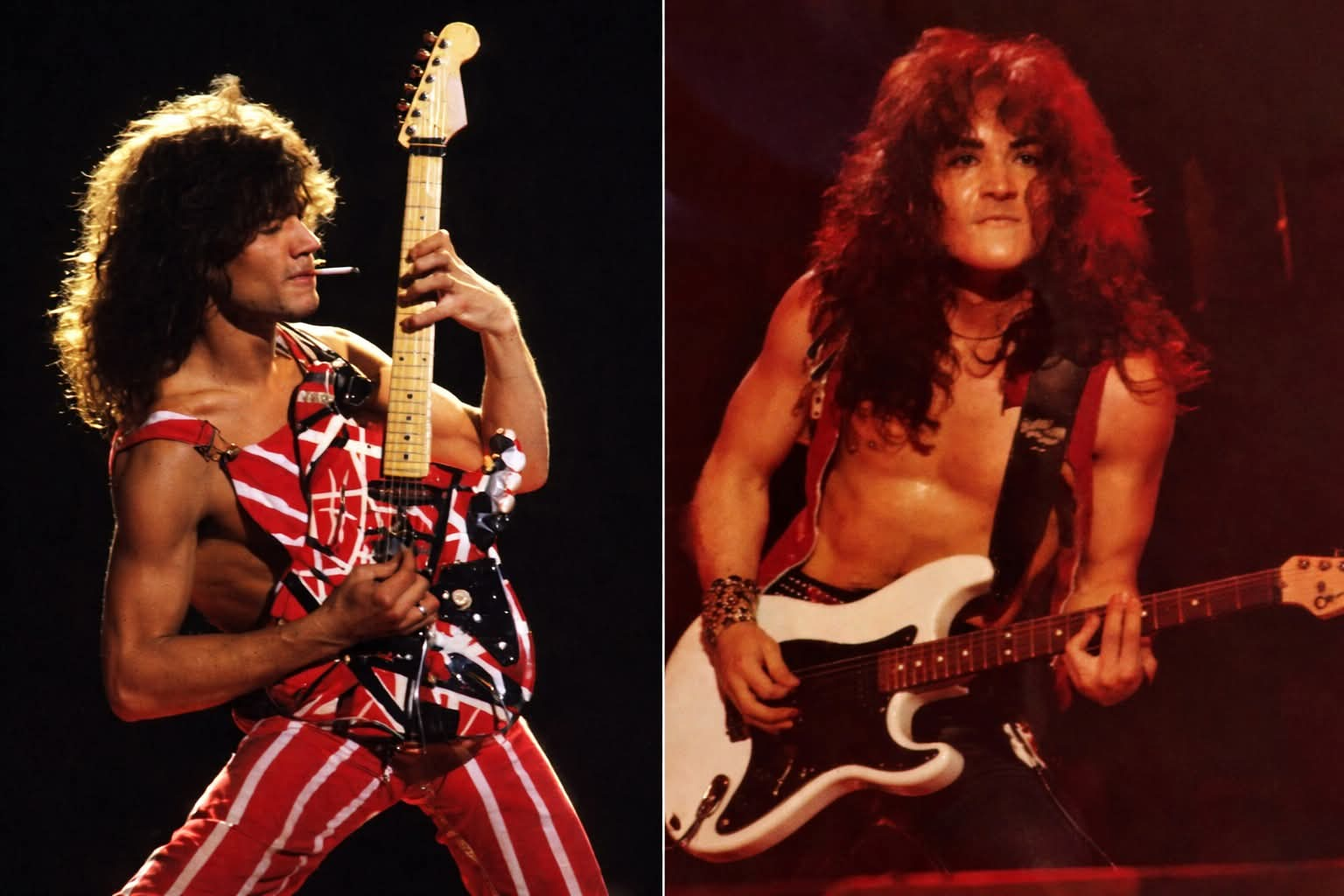
In the history of rock guitar, certain names serve as fixed points—monuments that define an era. If Eddie Van Halen is widely revered as the “father of modern guitar,” the innovator who smashed the boundaries of the 1970s and gifted the world the “brown sound,” then Jake E. Lee occupies a unique, perhaps even more complex space. While Van Halen provided the spark, Lee acted as the “scientist-artist,” taking those revolutionary tools and evolving them into darker, more technical, and deeply expressive territories.
From Innovation to Evolution
Eddie Van Halen’s impact was a “shot in the butt” to a rock scene that Lee himself once described as becoming “boring and predictable.” Van Halen’s tapping, palm muting, and flamboyant harmonics opened a door that many simply walked through. However, Jake E. Lee didn’t just walk through it; he re-engineered the room. Where Eddie’s playing was often characterized by a joyous, spontaneous “vanilla” brightness, Lee introduced a sophisticated grit. He utilized the same high-performance foundations but added layers of melodic complexity and a minor-key intensity that pushed the genre toward a more “next-level” technicality.
The Precision of a Scientist
Lee’s approach to the fretboard often feels like a masterclass in controlled chaos. His tenure with Ozzy Osbourne, specifically on albums like Bark at the Moon and The Ultimate Sin, showcased a guitarist who refused to rely on the standard “EVH” tropes. Lee famously avoided using a tremolo bar (the “whammy bar”), a staple of the era, opting instead to manipulate the neck of his guitar to achieve pitch bends. This decision forced him to develop a more precise, manual technique. Like a scientist refining a formula, Lee’s playing is characterized by fluid legato, complex phrasing, and a refusal to take the easy path through a solo.
The Melodic Complexity of the Artist
Beyond the speed and the “shred,” Lee’s true brilliance lies in his dark, expressive melodicism. His work with Badlands shifted the focus toward a blues-infused, raw power that felt both ancient and futuristic. While Van Halen’s solos often felt like a celebration, Lee’s frequently felt like a journey—winding through dissonant intervals and unexpected chromaticism. This “darker” path allowed him to create a mood that was distinctly his own, proving that technical proficiency doesn’t have to sacrifice emotional weight.
The Next Level of the Craft
To many aficionados, considering Jake E. Lee the “next level” isn’t a slight to the pioneers who came before him, but an acknowledgment of natural progression. If Van Halen broke the boundaries, Lee explored the uncharted territory beyond them. By blending the fire of hard rock with the discipline of a technician and the soul of a storyteller, Lee cemented his legacy as a player who didn’t just play the guitar—he evolved it. In the hands of Jake E. Lee, the instrument became a more complex, expressive, and hauntingly beautiful machine.