
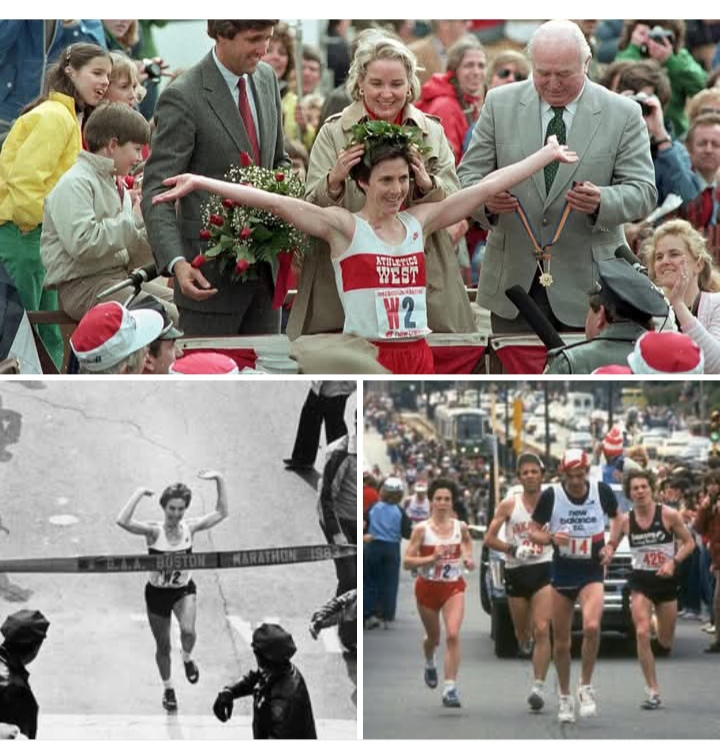
Forty-three years ago today, the asphalt of the Boston Marathon course didn’t just witness a race; it witnessed a seismic shift in the landscape of distance running. On April 18, 1983, a diminutive powerhouse from Maine named Joan Benoit (now Samuelson) surged through the historic route from Hopkinton to Copley Square, shattering expectations and the world record simultaneously. Her finishing time of 2:22:43 was more than just a personal best—it was a declaration that the ceiling for women’s athletics was far higher than the world had dared to imagine.
A Masterclass in Aggression
While many elite marathoners prefer a conservative start to gauge the field, Benoit chose a different path. Clad in her signature white singlet and grey shorts, she attacked the course from the opening gun. By the time she reached the halfway mark, she was running at a pace that seemed unsustainable to the commentators of the era. The “wall” that many runners hit in the final miles of Boston never materialized for Benoit. Instead, she turned the Newton Hills into her personal playground, maintaining a relentless cadence that left her competitors—and the previous world record—trailing in the dust.
Shattering the Glass Ceiling
Before Benoit’s 1983 performance, the women’s world record sat at 2:25:29, held by Grete Waitz. Benoit didn’t just nudge the needle; she obliterated the mark by nearly three minutes. This wasn’t merely a victory over other runners; it was a victory over the skepticism that still dogged women’s long-distance events in the early 80s. At the time, the women’s marathon had only recently been sanctioned for the upcoming 1984 Olympics. Benoit’s performance in Boston served as the ultimate proof of concept, legitimizing the event on the global stage and proving that female athletes possessed the physiological depth to handle elite-level endurance.
The Maine Native’s Second Crown
This was not Benoit’s first dance with glory in Boston. She had previously won the race in 1979 as a virtual unknown, setting an American record in the process. However, the 1983 win solidified her status as a legend. Her ability to navigate the fickle New England weather and the grueling topography of the Boston course twice in four years spoke to a psychological toughness that few could match. She ran with a grit that mirrored the rugged coastline of her home state, becoming a local hero whose influence extended far beyond the finish line.
A Legacy That Endures
As we look back over four decades later, the significance of 2:22:43 remains undiminished. While modern shoe technology and advanced training methods have allowed subsequent generations to lower the record further, the raw tenacity of Benoit’s run remains the gold standard for marathon spirit. She paved the way for the professionalization of women’s running, inspiring countless athletes to lace up their shoes and chase their own impossible times. Joan Benoit didn’t just run a race that day; she rewrote the history books, leaving a footprint on the sport that is as permanent as the finish line at Boylston Street.