
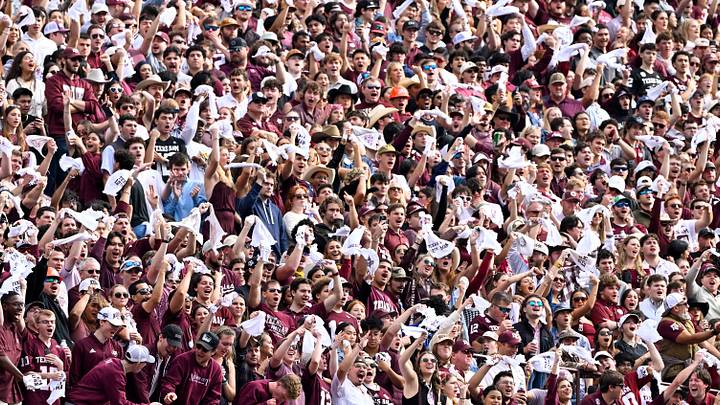
When it comes to college athletics, few institutions boast a cultural identity as deeply entrenched in ritual as Texas A&M University. The institution’s rich history and storied past have given rise to an array of long-standing customs that permeate nearly every facet of campus life. Nowhere is this unique environment more visible than inside Kyle Field on gameday, where over 100,000 maroon-clad supporters unite to create one of the most intense and distinctive atmospheres in all of American collegiate sports.
From orchestrated yells to coordinated movements, Aggie fans speak a shared language that sets them apart from every other fanbase in the country. Yet, even in a community that fiercely protects its heritage, time inevitably brings change. One of the program’s most peculiar and polarizing gameday habits is slowly fading into the background, giving way to a more conventional expression of fan frustration.
A Distinctive Custom Facing Organic Decline
For decades, Texas A&M faithful observed a strict unwritten rule when officiating went awry or opposing teams committed blatant penalties. Rather than unleashing a chorus of traditional boos, the crowd would collectively resort to a sharp, audible hiss. The practice was intended to demonstrate disapproval while maintaining a sense of decorum and remaining distinct from standard fanbase reactions.
However, as the program competes at the highest levels of modern college football, many supporters have begun questioning the efficacy of the gesture. Hissing may be unique, but to the uninitiated spectator or opposing player, it often lacks the visceral punch of a stadium-wide boom of dissatisfaction. In high-stakes conference games where energy and noise levels directly impact momentum, the desire for a stronger, more immediate sound has led many in the stands to reconsider.
The Practical Limitations of Hissing
The debate surrounding the hiss versus the boo is not entirely new, but the shift in spectator behavior has accelerated in recent years. The fundamental objective of expressing displeasure at a sporting event is to make the crowd’s frustration clear to officials, opponents, and television audiences. When an egregious penalty goes uncalled, a collective hiss can easily get lost in the ambient noise of a massive stadium.
Critics of the tradition point out that while originality is valuable, practicality should take precedence during crucial moments of competition. A loud, unified boo communicates instant, unambiguous disapproval that resonates across the field. For a fan base determined to provide the ultimate home-field advantage for their team, projecting maximum volume and intensity has become an increasingly high priority.
‘New Army’ Era Drives Cultural Evolution
The gradual demise of the hiss is largely attributed to younger generations of students and recent alumni, often referred to within the community as “New Army”. Attending games in an era defined by high-octane rivalries and intense national scrutiny, these younger fans are more inclined to adopt universal gameday behaviors. Listen closely to the crowd during recent home slates, and the audible rise of classic booing over traditional hissing becomes immediately apparent.
While traditionalists may view the shift with a touch of nostalgia or hesitation, the evolution appears to be happening naturally rather than through top-down mandates. Fans are simply choosing the most effective tool available to make their voices heard when bad calls occur on the field.
Embracing Progress Without Losing Identity
Texas A&M’s identity remains firmly anchored by its core values, revered customs, and unmatched spirit. Letting go of an inefficient habit does not dilute the passion of the 12th Man; rather, it highlights a fan base willing to adapt to the modern athletic landscape. As Kyle Field continues to host classic SEC battles, Aggies are proving that they can preserve their rich legacy while leaving outdated practices in the past.