
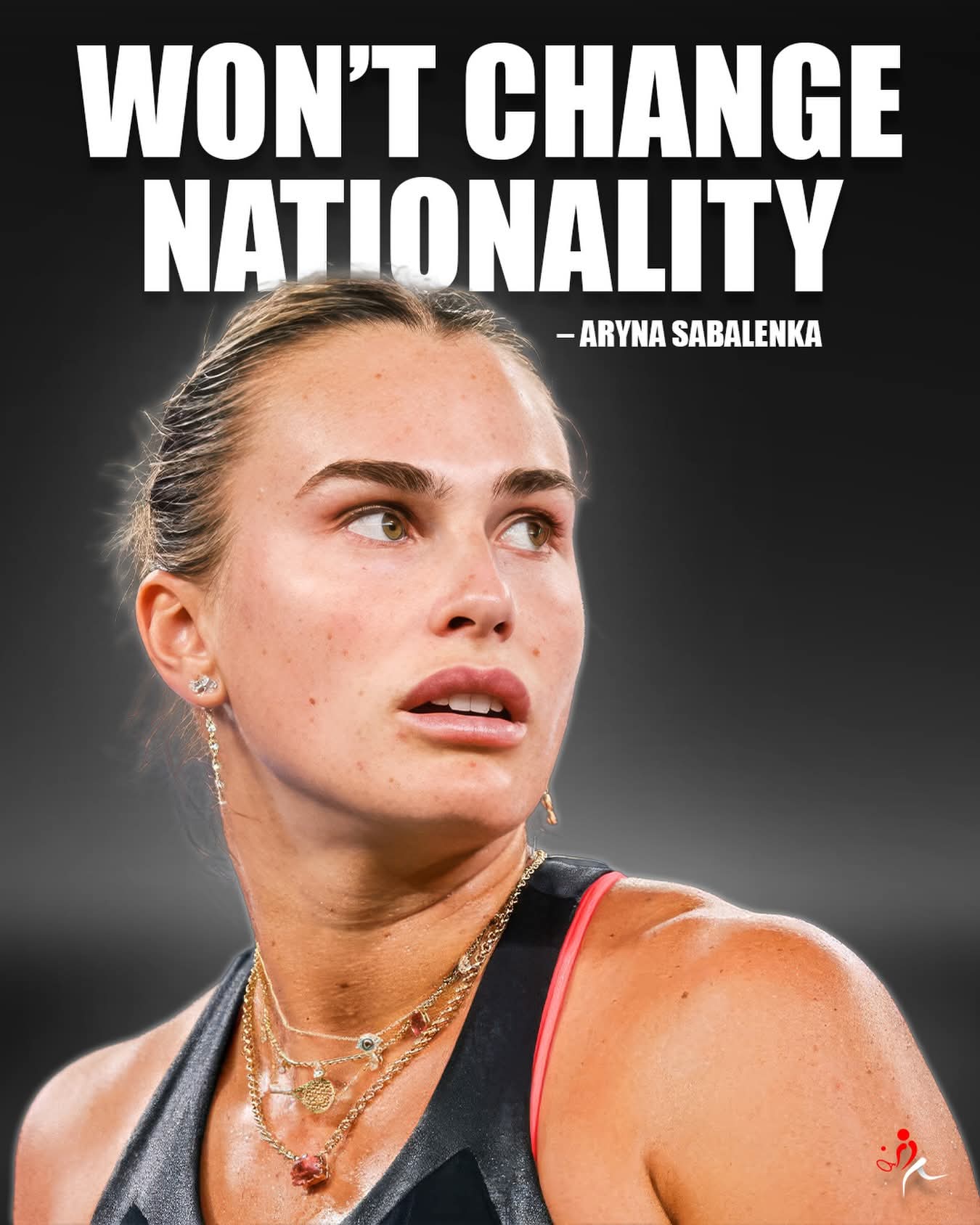
In an era of professional tennis where shifting allegiances have become increasingly common, world No. 1 Aryna Sabalenka has drawn a firm line in the sand. Amidst a wave of Russian and Belarusian players seeking new passports to bypass international restrictions, Sabalenka has definitively ruled out changing her sporting nationality. In a poignant interview on Piers Morgan Uncensored this week, the two-time reigning WTA Player of the Year made it clear that her loyalty is not to a flag or a federation, but to the next generation of athletes in her homeland.
A Vow of Loyalty to the Next Generation
The speculation surrounding Sabalenka’s nationality has intensified as several high-profile peers—including at least ten Russian players in the last year—opted for citizenship in nations like Uzbekistan, Kazakhstan, or France. These moves are often seen as strategic efforts to escape the “neutral” status imposed by the ITF and WTA following global geopolitical conflicts. However, for Sabalenka, the prospect of wearing a different patch on her sleeve feels like a fundamental betrayal.
“Changing my nationality is not in my plans. I don’t want to betray those children,” Sabalenka stated. The “Tiger,” as she is known for her fierce on-court persona, showed a softer side as she discussed the weight of being a role model. “I want to represent Belarus for those children who look up to me and are inspired by me. I want them to see me competing at a high level and know that if I could make it from such a small country to the very top, they can too.”
The Burden of Neutrality
Since 2022, Sabalenka has navigated the tour without a national flag or anthem, a consequence of international bans on Belarusian and Russian representation. While she has expressed sadness over the lack of national symbols next to her name—notably during her deep runs at the 2025 Australian Open and US Open—she has remained remarkably consistent in her performance. In 2025 alone, she banked over $15 million in prize money and secured four titles, including her second consecutive US Open crown.
Despite the “neutral” label, Sabalenka insists that her identity remains tethered to Minsk. She frequently reminds the media that she did not sharpen her game in the elite academies of Florida or Spain, but rather in the local courts of Belarus. For Sabalenka, switching nationalities would erase the “homegrown” narrative that she believes fuels the dreams of young Belarusian tennis players.
Looking Toward the 2026 Season
As the 2026 season approaches, Sabalenka is set to begin her campaign in Brisbane, still holding the world No. 1 ranking. Her decision to remain a Belarusian athlete, even without the formal trappings of a flag, serves as a stabilizer for a sport currently rocked by coaching splits and shifting allegiances.
By prioritizing her role as an inspiration over political or logistical convenience, Sabalenka has solidified her status as more than just a power hitter. She is a symbol of continuity. While she may continue to walk onto the world’s biggest stages under a neutral banner, her message to the children back home is louder than any anthem: she is still one of them, and she isn’t going anywhere.