
The intersection of elite professional sports and high-profile American politics has once again taken center stage, transforming what was supposed to be a historic evening of New York basketball into a lightning rod for cultural debate. When the New York Knicks returned to Midtown Manhattan to host the San Antonio Spurs for Game 3 of the 2026 NBA Finals, the electric atmosphere inside Madison Square Garden was palpable. However, the narrative shifted dramatically when sitting U.S. President Donald Trump made a high-profile appearance as a guest of team owner James Dolan, instantly igniting a wave of online discourse and sharply dividing the basketball community.
Riding a wave of intense postseason euphoria, Knicks fans had been waiting over two decades to experience a championship series at the iconic “Mecca” of basketball. The team had stolen two thrilling games in San Antonio to build immense momentum, creating a rare, unifying buzz across all five boroughs. But when Trump’s face appeared on the center-court Jumbotron during the singing of the national anthem, the pure sporting energy of the arena was met with a massive, roaring chorus of boos and jeers from the heavily localized crowd, revealing the deep ideological rifts that continue to permeate modern sports culture.
Disruption to the Championship Rhythm
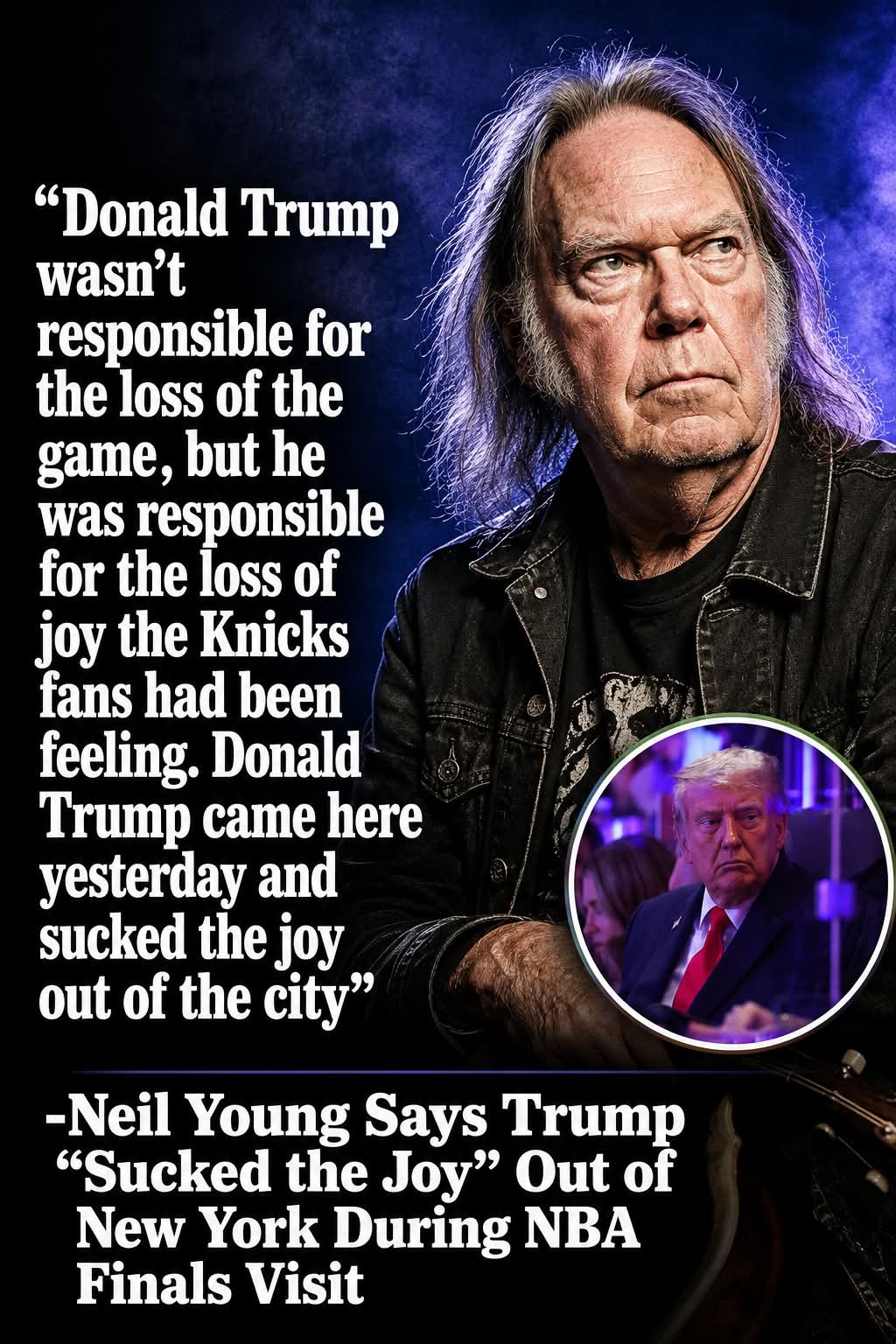
In the wake of the Knicks’ highly competitive 115-111 loss to Victor Wembanyama and the Spurs, rock legend and noted social activist Neil Young reportedly added his voice to the growing chorus of observers critiquing the evening’s atmosphere. According to discussions circulating widely across digital fan networks, the iconic singer-songwriter suggested that the intense political spectacle actively disrupted the emotional rhythm of the night. Young reportedly argued that the sudden intrusion of partisan politics stripped the event of its organic, community-driven identity, shifting the focus away from the hard-working athletes and the desperate fans who had invested so much emotional equity into the postseason run.
The critique extends far beyond mere fan acoustics, highlighting the heavy structural footprint that accompanies a presidential visit. Hours before tip-off, the Secret Service and local law enforcement implemented a massive, multi-block security perimeter around Madison Square Garden, complete with ten-foot security fencing and TSA-style magnetometers. The intense protocols forced the cancellation of the raucous outdoor fan watch parties that had defined earlier rounds, leading many traditional ticket holders to complain that the arena felt more like a secure government facility than a celebration of New York hoops.
A City Divided Over a Sporting Spectacle
The fallout from the evening has left basketball purists and political analysts fiercely locked in opposing camps. Defenders of the president’s visit argue that as a native New Yorker and a lifelong, historic fan of the franchise, Trump had every right to occupy a baseline luxury suite and support his hometown team on the grandest stage. They contend that a presidential appearance adds an undeniable layer of prestige, marking the very first time a sitting U.S. commander-in-chief has ever attended an NBA Finals game in person.
Conversely, critics echo the sentiment that sports should remain a safe, neutral sanctuary detached from the exhausting polarization of contemporary political campaigns. For thousands of fans who endured grueling security lines and watched their team’s historic win streak come to a heartbreaking end, the night will be remembered just as much for its political noise as its on-court drama. As the series pushes forward, the debate over Game 3 serves as a stark reminder that in the modern era, the brightest lights of Madison Square Garden can never completely escape the shadow of the national spotlight.