
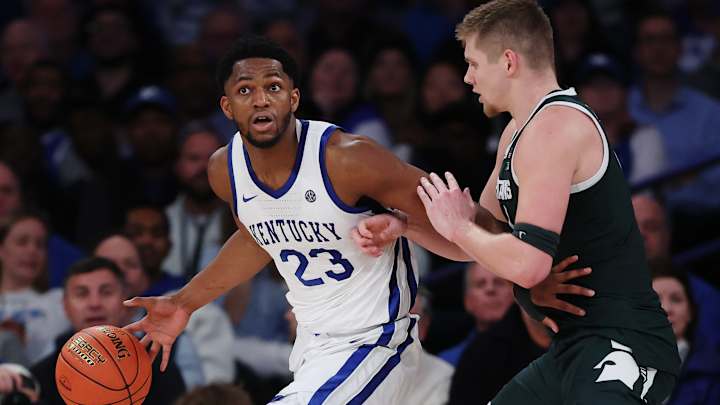
🏀 LEXINGTON, KY – In the high-stakes world of NCAA Basketball, every tactical decision by a head coach is scrutinized, and few positions are as crucial to a modern offense as floor spacing. For Kentucky Basketball Head Coach Mark Pope, the path to offensive fluidity runs directly through a conundrum involving one of his most vital players, transfer forward Mo Dioubate.
Dioubate, who arrived in Lexington from Alabama, has been nothing short of a revelation this season. He embodies the grit and relentless energy that the Kentucky Wildcats often need, bringing elite defense, overwhelming physicality, and a SEC veteran’s hustle.
The Dioubate Paradox: Production vs. Pope’s System
The 6-foot-5 forward’s season stats make a compelling case for maximizing his court time:
* PTS: 11.6 per game
* REB: 5.8 per game
* FG%: 62.2\%
Dioubate is incredibly efficient inside the arc, consistently securing rebounds and finishing powerfully. However, this production is countered by a singular, glaring weakness that is actively suffocating Pope’s preferred offensive scheme: a non-existent outside shot. Dioubate is currently 1-for-11 from three-point range, allowing opposing defenses to implement a costly strategy.
In Pope’s “pace-and-space” system, which relies on four or five shooters to create driving lanes, Dioubate’s presence at the power forward (4-spot) allows defenders to sag off him entirely. This sags the defense into the paint, effectively clogging the critical driving lanes necessary for dynamic guards like Otega Oweh and Jasper Johnson, hamstringing the entire offense. This makes the question of how to integrate Dioubate’s unique talents a critical issue for the Wildcats.
The Small-Ball Solution: Dioubate at the Five
Facing this internal contradiction, Mark Pope revealed a fascinating tactical adjustment that could be the “small ball twist” necessary for Kentucky to reach its ceiling. The coach confirmed that the team is preparing to deploy the undersized but powerful forward at the center position—the 5-spot—in specific, high-leverage situations.
“I do think there’s a space for Mo at the five situationally,” Pope said. “Mo is 6-5. He plays a lot bigger than that… there will be moments he’s so physical, we can do it.”
This move is a direct attempt to unlock Kentucky’s spacing without sacrificing Dioubate’s indispensable presence. By positioning the 6’5” Dioubate at the center position, he transitions from being the “clogger” at the 4-spot to the “roller” and primary rim protector at the 5-spot.
Tactical Advantages of “Small-Ball Mo”
* Surrounded by Shooters: Playing Dioubate at the 5 allows Pope to surround him with four perimeter shooters, forcing opposing centers out of the paint to defend pick-and-pop actions. This instantly clears the floor, opening up vital driving lanes for the Wildcat backcourt.
* Increased Pace: Dioubate’s athleticism and relentless motor at the center position will likely speed up the pace, perfectly aligning with Pope’s system goals.
* Physicality Advantage: Though undersized, Dioubate’s strength allows him to “play bigger” than his height, utilizing his physicality to bang against traditional centers and execute quick, powerful drives to the basket before the defense can react.
Pope admitted the tactic will make Kentucky “actually really small,” but given the alternative of a stagnated offense, this innovative approach is rapidly becoming the most viable solution.
Fans of college basketball should expect to see this new, aggressive “Small Ball Mo” lineup debut in upcoming high-profile contests, such as the battles against strong opponents like North Carolina and Gonzaga. This experiment, a bold tactical compromise to maximize the production of an outlier player, could define Mark Pope’s debut season as the Kentucky coach and provide the key to a successful March Madness campaign.