
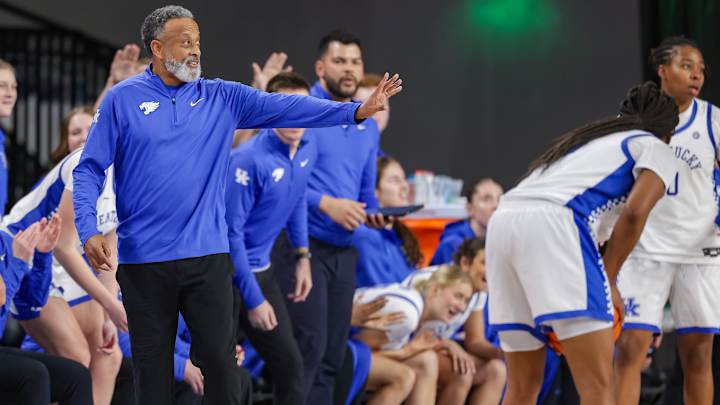
The final box score will show Kentucky edging Oklahoma 63–57, but for head coach Kenny Brooks, Sunday’s win over the No. 5 Sooners carried significance far beyond the numbers. It was a response, a reckoning, and a declaration of resilience from a team that had been shaken just days earlier.
Coming off a humbling loss to Alabama, Kentucky entered the matchup searching for identity. The challenge was even steeper without injured forward Teonni Key, whose absence forced the Wildcats to adjust on the fly. Early on, it looked like Oklahoma’s relentless pace and physicality would expose every crack. The Sooners stormed out to a 24–11 lead, controlling tempo and confidence while Kentucky appeared unsettled and overwhelmed.
But the game did not follow that script for long.
What began as a night of frustration slowly transformed into one of resolve. Kentucky dug in defensively, absorbed the physicality, and began to push back. By the final buzzer, the Wildcats had done something remarkable: they held one of the nation’s most explosive offenses to just 23 points in the second half, flipping the game through toughness and discipline. The victory marked Kentucky’s second win over a top-five opponent this season and may have been its most defining.
After the game, Brooks was visibly emotional, struggling to put into words what the performance meant to him.
“First and foremost, I don’t know if I’ve ever been more proud of a group of young people,” Brooks said. “The way they came out, obviously with the circumstances, and still having remnants of Teonni’s absence, trying to reinvent ourselves into what we’re going to be in a very short amount of time while you’re playing top-notch opponents.”
The early moments were anything but smooth. Kentucky struggled to keep pace with Oklahoma’s speed and decisiveness, often arriving a step late on both ends of the floor. The Sooners, known for playing at a breakneck tempo, forced the Wildcats into uncomfortable situations.
“Oklahoma does a tremendous job; they are the fastest team in the country,” Brooks explained. “They get the ball up and down the floor, they have the most possessions, and it took us a little while to figure out that they were going to be that aggressive. And then once we settled in, then it became a very physical basketball game.”
That physicality ultimately became the equalizer. Kentucky embraced it rather than retreating from it. Defensive stops fueled confidence, confidence fueled composure, and composure allowed the Wildcats to grind their way back into control.
Brooks also pointed to his team’s response to adversity as the most encouraging takeaway. Instead of splintering under pressure, the Lady Cats leaned into each other, finding contributions beyond the stat sheet.
One of the pivotal moments came from Jordan Obi, who struggled offensively early, missing several close-range opportunities. Rather than disappearing, Obi continued to attack, defend, and hustle. A key effort play just before halftime, highlighted by Brooks, helped swing momentum and embodied the mindset Kentucky needed to survive.
It was not a flawless performance, but it was an honest one — built on effort, adaptability, and belief. Against a top-five opponent that tried to bully them early, Kentucky chose to give it right back. In doing so, the Wildcats may have discovered something more valuable than a win: a blueprint for who they can be when the game gets uncomfortable.