
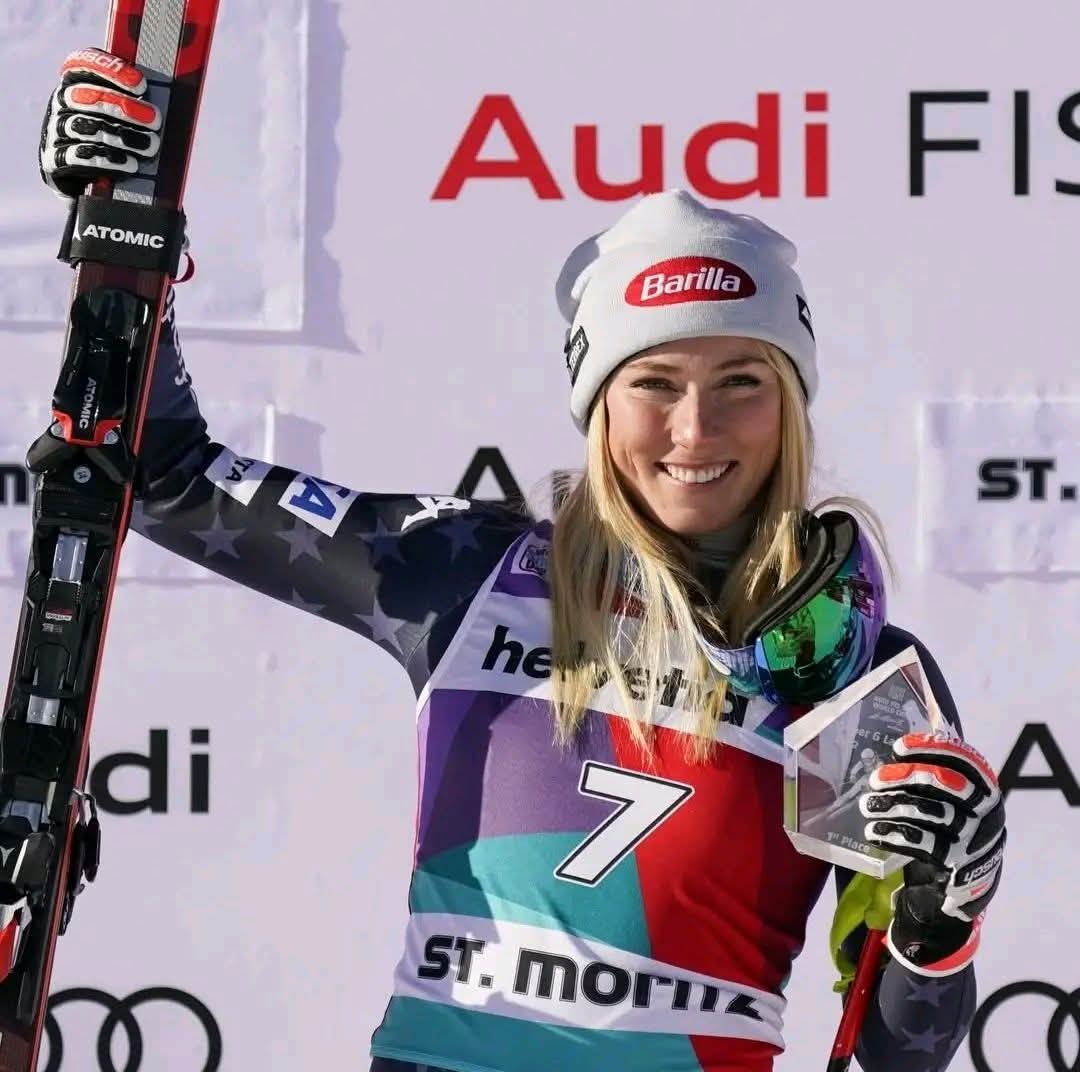
On a freezing night under the floodlights of Courchevel, France, Mikaela Shiffrin proved once again why she is the undisputed queen of technical skiing. On December 16, 2025, the American superstar secured her 105th World Cup victory, maintaining a perfect record in slalom this season. However, despite a dominant final margin of 1.55 seconds, Shiffrin admitted to feelings of profound relief after surviving a treacherous second run on the Stade Émile Allais.
Shiffrin’s evening began with a masterclass in the first heat, where she carved out a 0.83-second advantage over Swiss rival Camille Rast. But as the temperature dropped and the course began to break down, the second run turned into a war of attrition that saw several top contenders—including Germany’s Lena Duerr and Albania’s Lara Colturi—fail to finish.
Navigating the Bumps: A Battle of Discipline
As the final skier out of the gate, Shiffrin faced a course riddled with “chatter marks” and deep ruts. While her lead appeared safe on paper, the physical reality of the slope was far more chaotic. Shiffrin described the second run as “hard to predict,” noting that the surface varied wildly from turn to turn.
“That was a tough second run,” Shiffrin said after catching her breath in the finish area. “Some turns had big tracks and others were really good. It was a bit difficult to predict where it would be bumpy and where you could fly well. Sometimes I had trouble staying on line, but staying disciplined worked out.”
The intensity of the run was so high that Shiffrin confessed she wasn’t always sure she would reach the bottom. “I had moments where I didn’t think I was going to make it to the finish—I just had to keep pushing. It’s a wonder that I made it this time.”
The “Perfect Streak” and the 1.5-Second Standard
The win in Courchevel marks Shiffrin’s fourth straight slalom victory of the 2025–26 season, keeping her undefeated in the discipline. Her average margin of victory this winter has reached a staggering 1.50 seconds—an “eternity” in a sport often decided by hundredths.
Despite these lopsided scoreboards, Shiffrin refuses to get comfortable. She credited her massive first-run lead as the “cushion” that allowed her to navigate the deteriorating conditions of the final heat. Behind her, Switzerland’s Camille Rast secured her second podium of the year in second place, while Germany’s Emma Aicher continued her hot streak by finishing third, just days after a downhill win in St. Moritz.
Pushing Through Fatigue Toward the Holidays
The victory comes at the end of a grueling nine-week stretch that has seen Shiffrin travel from Finland to Colorado and back to the Alps. While the results suggest she is at the peak of her powers, the 30-year-old champion admitted that the physical and mental toll is mounting.
“I’m pretty tired, but also kind of energized right now,” Shiffrin reflected. “These nine weeks have been such a big push.” She emphasized that the success is a “team effort,” praising her coaches and technicians for providing the equipment and support necessary to handle the unforgiving ice of Courchevel.
A Well-Deserved Break Before Semmering
With 105 wins in the bag and her lead in the FIS overall standings expanded, Shiffrin will now head into a short Christmas break. She has expressed a desire to refine her Giant Slalom and Super G training during the hiatus, as she builds momentum toward the 2026 Winter Olympics.
The World Cup circuit resumes on December 28 in Semmering, Austria, where the world will watch to see if anyone can finally close the gap on the most dominant athlete in the history of the sport.