
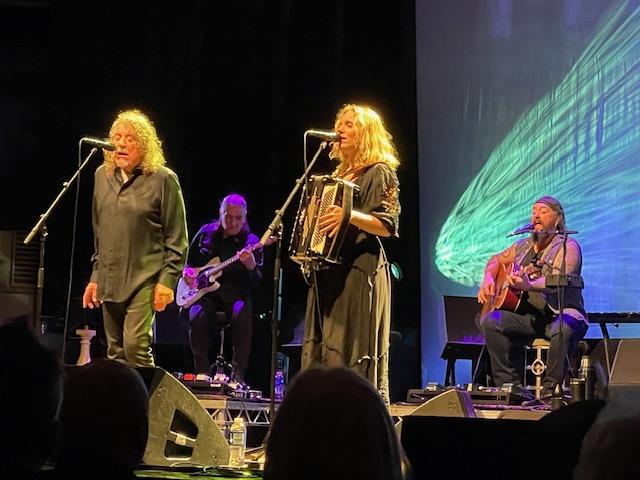
GLASGOW, Scotland — “We’re Saving Grace,” Robert Plant announced with a playful, knowing glint in his eye midway through his performance at the Royal Concert Hall. It was a simple introduction, but one that carried the weight of a legendary career that has successfully transitioned from the stadium-shaking thunder of hard rock to the intricate, ethereal textures of global folk and blues.
Joined by the superlative quintet he has spearheaded for over half a decade, the former Led Zeppelin frontman proved once again that while his past is monumental, his musical present is where his soul truly resides. In Glasgow, the man often described as a “global village explorer” led his audience on a journey through the dusty corners of Americana, the haunting echoes of British folk, and the rhythmic complexities of world music.
A Quintet of Superlative Precision
The magic of the evening was rooted in the chemistry between Plant and his Saving Grace collaborators. This isn’t a backing band for a legacy act; it is a true ensemble where the vocals of Suzi Dian provide a sublime counterpoint to Plant’s seasoned, soulful delivery. For more than five years, this unit has refined a sound that feels both ancient and immediate.
Throughout the set, the interplay between the acoustic and electric instruments created a tapestry of sound that filled the Royal Concert Hall without ever feeling overbearing. The quintet’s ability to pivot from the quietest, pin-drop whispers of a folk ballad to the driving, hypnotic pulse of a blues-rock groove demonstrated a mastery of dynamics that few contemporary acts can match.
Curating the Lesser-Known Classics
Rather than leaning on the predictable “greatest hits” of his youth, Plant’s setlist was a curated collection of lesser-known covers and reimagined traditionals. This choice reflects his ongoing commitment to musical archaeology—digging up forgotten gems and polishing them for a modern audience.
The performance touched on folk, blues, and rock-pop covers, each delivered with a sense of reverence and reinvention. By stripping away the expectation of a Led Zeppelin-style spectacle, Plant allowed the songwriting and the vocal harmonies to take center stage. It was a reminder that at his core, Plant is a storyteller who uses his voice as a vessel for the songs of others as much as his own.
The Evolution of a Legend
There is a specific joy in watching a performer of Plant’s stature embrace the freedom of his later years. At the Royal Concert Hall, there was no pressure to hit the high-octane notes of 1971; instead, he explored the richness of his lower register and the nuance of his phrasing.
His playful stage presence suggested a man who is genuinely invigorated by this collective. Saving Grace represents the culmination of Plant’s post-Zeppelin wanderlust—a project that blends his love for the Appalachian hills with the mystical vibes of the Welsh borders.
A Night of Transcendent Harmony
As the final notes faded into the Glasgow night, it was clear that Saving Grace is more than just a side project. It is a testament to the power of artistic curiosity. For those in attendance, it was a rare opportunity to see a global icon in an intimate, communal setting, proving that Robert Plant’s voice remains one of the most compelling instruments in the history of popular music.