
Legal Challenge Filed in Washington
A coalition of U.S. citizens and immigrant rights organizations has filed a lawsuit challenging the Trump administration’s sweeping suspension of immigrant visa processing for nationals of 75 countries. The legal complaint, submitted in Washington, DC, argues that the measure represents one of the most expansive restrictions on legal immigration in modern U.S. history and unlawfully targets individuals based on nationality.
The plaintiffs contend that the policy has disrupted families, delayed reunifications, and blocked employment-based immigration pathways. They are asking the court to halt implementation of the suspension and declare it unconstitutional.
Allegations of a “False Narrative”
At the center of the lawsuit is the claim that the administration relied on what the plaintiffs describe as a “false narrative” to justify the suspension. According to the complaint, officials have asserted—without sufficient evidence—that nationals from the affected countries are likely to depend on public welfare programs if admitted to the United States.
The lawsuit challenges that assertion as unsupported and misleading. It argues that the administration has failed to provide credible data demonstrating that immigrants from the listed countries disproportionately rely on public benefits. Instead, plaintiffs say, the policy appears to rest on broad generalizations rather than documented trends.
Claims of Nationality-Based Discrimination
The complaint further alleges that the suspension amounts to an unlawful nationality-based ban on legal immigration. Backers of the case argue that U.S. immigration law prohibits discrimination solely on the basis of nationality when issuing immigrant visas.
In its case overview, the National Immigration Law Center, one of the advocacy groups supporting the challenge, states that the measure effectively creates a new and discriminatory framework under the guise of public charge enforcement. The organization contends that the administration’s approach denies applicants the procedural protections guaranteed by federal law.
Legal analysts say courts will likely examine whether the executive branch exceeded its statutory authority in implementing the suspension and whether the measure violates equal protection principles embedded in U.S. law.
Impact on Families and Workers
Families affected by the suspension say the policy has caused emotional and financial strain. U.S. citizens sponsoring relatives from impacted countries report indefinite delays in visa processing, leaving spouses, children, and parents separated across borders.
Employment-based immigrants are also caught in the freeze, according to the lawsuit. Businesses that rely on skilled foreign workers argue that prolonged suspensions undermine economic growth and disrupt workforce planning.
Advocacy groups stress that the public charge rule—designed to assess whether an immigrant is likely to depend primarily on government assistance—has long existed but was historically applied on an individualized basis. The lawsuit alleges that the new suspension transforms that assessment into a blanket presumption against entire nationalities.
Administration’s Position
The Trump administration has defended its immigration policies as necessary to protect U.S. economic interests and ensure that new immigrants are self-sufficient. Officials argue that the federal government has broad authority to regulate immigration and determine eligibility standards for entry.
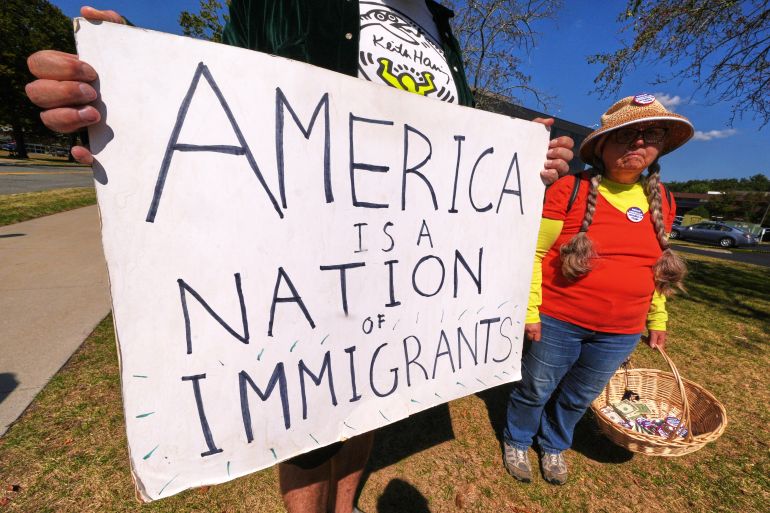
Supporters of the policy say stricter enforcement ensures fairness to taxpayers and strengthens immigration integrity. However, critics counter that sweeping suspensions risk undermining America’s longstanding reputation as a nation built by immigrants.
What Comes Next
The case is expected to move through federal court in the coming months, potentially setting the stage for a broader debate over executive power and immigration policy. If the court sides with the plaintiffs, the administration could be required to reinstate visa processing for affected countries.
For now, families and applicants remain in limbo, awaiting judicial review that could shape the future of U.S. legal immigration policy.