
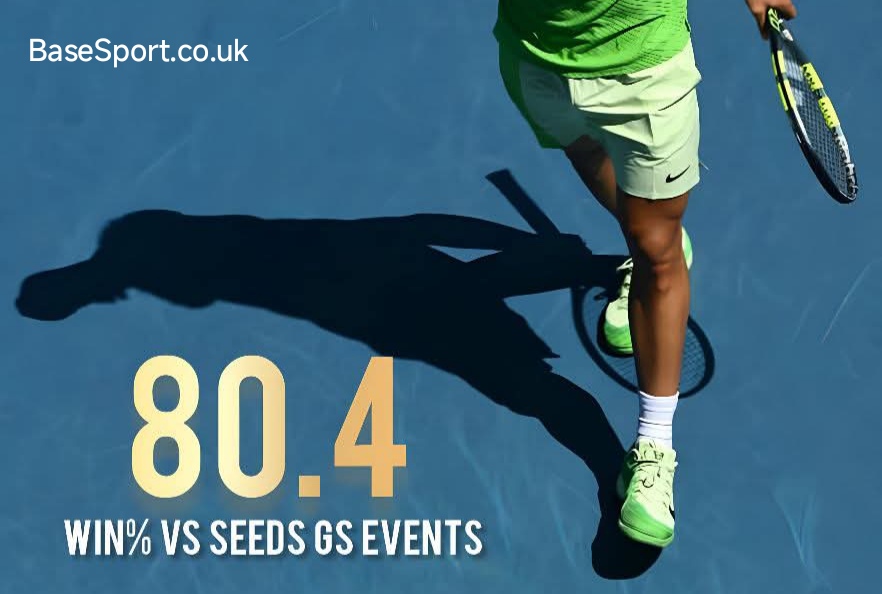
Carlos Alcaraz has added another remarkable milestone to his rapidly growing résumé, establishing himself as the most efficient giant-killer in Grand Slam history. With a win percentage of 80.4% against seeded opponents at the majors, Alcaraz now owns the best mark of the Open Era, edging past Rafael Nadal’s long-standing record of 80.1%.
The statistic is as striking as it is symbolic. Nadal’s dominance at Grand Slams has long been viewed as an untouchable benchmark, particularly when facing elite competition under the highest pressure. For Alcaraz to surpass that figure—while still in the early years of his career—underscores just how quickly he has redefined expectations.
Unlike many young stars who build early success against lower-ranked opposition, Alcaraz has thrived when the stakes are highest and the competition toughest. Time and again, he has shown a remarkable ability to elevate his level against the sport’s best, blending fearless shot-making with tactical intelligence well beyond his age.
The Spaniard’s record against seeded players reflects more than raw talent. It highlights his adaptability across surfaces, formats, and playing styles. Whether grinding through marathon baseline rallies on clay, absorbing pace on hard courts, or finishing points decisively on grass, Alcaraz has consistently found solutions against opponents designed to expose weaknesses.
What makes the achievement even more compelling is the context. Seeded players at Grand Slams represent the most complete, battle-tested competitors in the game—athletes accustomed to pressure, momentum swings, and hostile environments. Beating them once can be a breakthrough. Beating them more than 80 percent of the time speaks to sustained excellence.
Alcaraz’s rise has often drawn comparisons to the legends who came before him, but this statistic places him firmly in that conversation on its own terms. Nadal’s mark was built over nearly two decades of dominance, defined by physical resilience and mental iron. Alcaraz, by contrast, is crafting his legacy through explosive athleticism, creative shot selection, and a fearless approach that embraces risk rather than avoids it.
At Grand Slams, where matches stretch to best-of-five sets and pressure compounds with every round, Alcaraz’s mental strength has been just as important as his physical gifts. He has shown an uncommon ability to reset after setbacks, respond immediately to momentum shifts, and close out matches against seasoned opponents who refuse to fade quietly.
The Australian Open has once again provided a stage for those qualities to shine. As the tournament unfolds, Alcaraz’s presence looms large—not just because of his ranking or recent form, but because history suggests he thrives when challenged by the best. Seeded opponents do not intimidate him; they sharpen him.
For Spanish tennis fans, the statistic carries added resonance. Nadal’s influence on Alcaraz has been widely acknowledged, from competitive mindset to national pride. Surpassing Nadal in any Grand Slam metric is no small feat, and doing so at such a young age hints at a future filled with records yet to be imagined.
While numbers alone do not define greatness, they often reveal its trajectory. In Alcaraz’s case, the trajectory is unmistakable. With every major appearance, he is not just winning matches—he is rewriting what is possible.
And with his best years still ahead, the record he now owns may only be the beginning.