
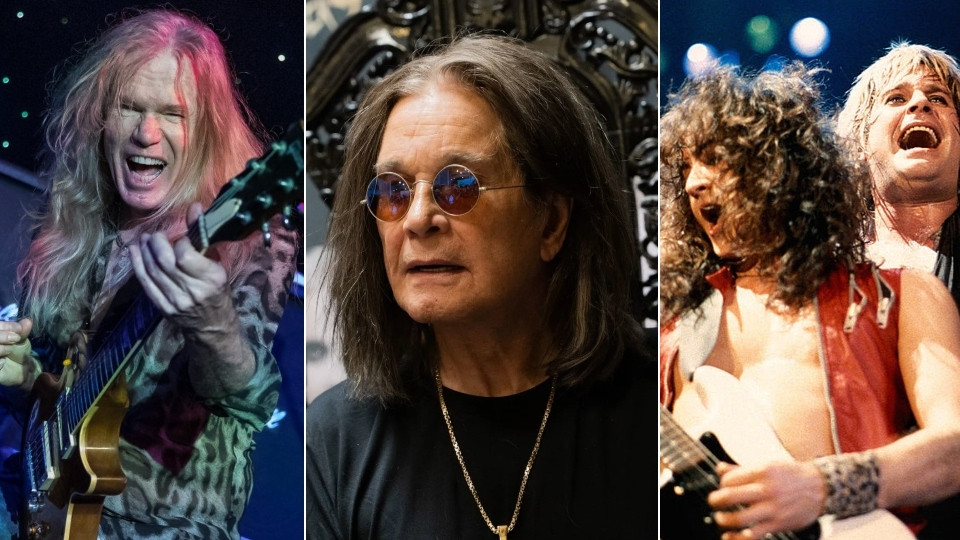
Guitarist Adrian Vandenberg has revealed that he was once approached by Ozzy Osbourne about the possibility of joining his solo band, a revelation that adds another fascinating chapter to the long and complex history of guitarists connected to the Prince of Darkness. According to Vandenberg, the conversation took place during the early 1980s, a period when Ozzy’s band was still finding its footing following the tragic death of Randy Rhoads.
Speaking in a recent interview with The Metal Voice, Vandenberg explained that the offer came at a time when Jake E. Lee had already stepped into the spotlight as Rhoads’ successor. Despite Lee’s growing reputation and strong presence in Ozzy’s band, Osbourne and members of his inner circle were still quietly evaluating options, a common practice during a turbulent era marked by lineup changes and creative uncertainty.
Vandenberg suggested that his name came up largely due to stylistic considerations. According to him, keyboardist Don Airey and others close to the band felt his melodic approach and classical-influenced phrasing bore a closer resemblance to Randy Rhoads’ style than many of the other guitarists being discussed at the time. That similarity, Vandenberg believes, is what placed him on Ozzy’s radar.
While the discussions never evolved into a formal contract, the connection may explain why Vandenberg’s band, Vandenberg, ended up opening for Ozzy Osbourne during his 1984 tour. At the time, opening slots were rarely accidental; they were often extended to artists Ozzy respected or wanted to observe more closely in a live setting. For Vandenberg, the opportunity was both a career boost and a glimpse into what might have been.
The early 1980s were a defining period for Ozzy Osbourne’s solo career. The sudden loss of Randy Rhoads in 1982 left an irreplaceable void, and while Jake E. Lee ultimately became the public face of the band’s guitar role during that era, he was far from the only player considered. A long list of high-profile guitarists either auditioned, were discussed internally, or briefly crossed Ozzy’s path before the lineup stabilized.
Vandenberg’s story places him among those nearly-forgotten names—musicians whose paths briefly intersected with Ozzy’s but never fully merged. In hindsight, the moment is particularly intriguing given Vandenberg’s later success with Whitesnake, where his songwriting and guitar work played a key role during a transitional phase for the band. His stint with Whitesnake, though relatively short, proved pivotal, producing material that helped shape the band’s late-1980s sound.
Asked directly whether he had also been considered by KISS, another band his group once opened for, Vandenberg confirmed that conversations occurred there as well. However, much like the Ozzy situation, those talks never developed into a long-term collaboration. Instead, Vandenberg continued carving out his own path, balancing solo ambitions with high-profile band work.
Looking back, Vandenberg appears philosophical rather than regretful. He views the near-miss with Ozzy Osbourne as an affirmation of his talent rather than a lost opportunity. Being mentioned in the same breath as Randy Rhoads and Jake E. Lee, he noted, is an honor in itself—one that underscores the respect he commanded among peers at the height of the hard rock and heavy metal era.
In the grand narrative of Ozzy Osbourne’s solo career, Adrian Vandenberg’s story serves as a reminder of how many influential musicians orbited the band during its most volatile years. While he never officially joined Ozzy’s ranks, his brief proximity to that world remains a compelling footnote in rock history—one shaped by timing, style, and the enduring shadow of a legend gone too soon.