
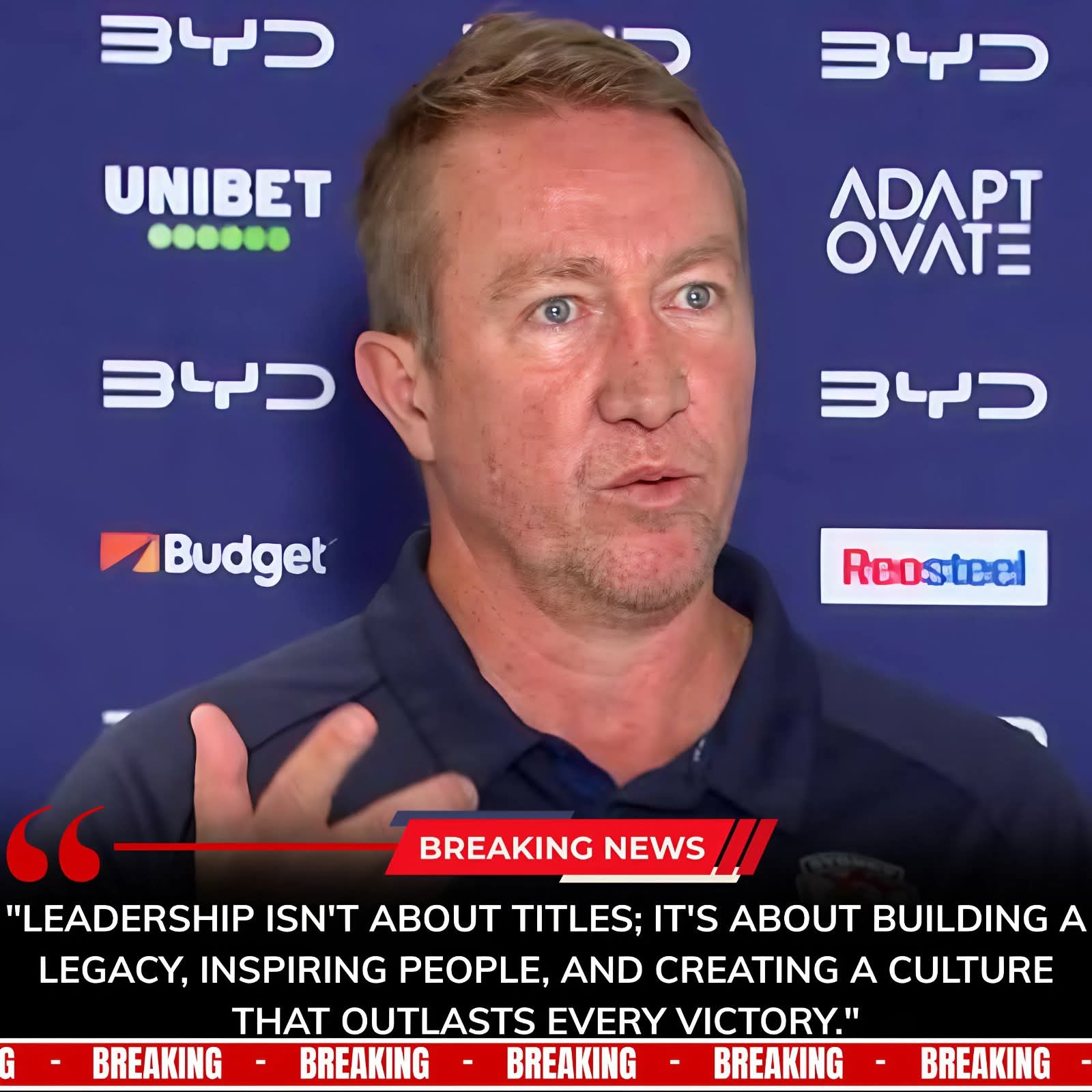
The Sydney Roosters have sent shockwaves through the rugby league community by announcing a revolutionary restructuring of their front-office operations. In a move that has caught rivals completely off guard, the foundation club has appointed long-serving head coach Trent Robinson to the newly created position of Managing Director of Football. This fictional administrative promotion marks the beginning of an ambitious new era for the Tricolours, blending on-field tactical brilliance with overarching corporate strategy. Under this innovative framework, Robinson will transcend the traditional boundaries of a first-grade coach, gaining total autonomy over the club’s entire football program, junior pathways, recruitment networks, and long-term sporting philosophy.
A Visionary Elevated to Total Football Command
By elevating Robinson to the role of Managing Director, the Roosters’ board has signaled its absolute faith in the three-time premiership-winning coach’s broader vision. This strategic transition allows the club to fully capitalize on Robinson’s sophisticated understanding of sports science, talent identification, and organizational culture. While he will maintain an active, daily presence on the training paddock, his expanded mandate tasks him with building a bulletproof sporting system designed to guarantee success for the next decade. Supporters have reacted to the news with overwhelming enthusiasm, flooding digital forums to express their belief that Robinson’s intellect and deep loyalty make him uniquely qualified to future-proof the proud Bondi franchise.
Redefining the Traditional Coaching Blueprint
The decision to install a active coach as an executive director represents a fascinating, calculated gamble that challenges the traditional coaching architecture of the National Rugby League (NRL). Historically, clubs have strictly separated the roles of head coach and football manager to prevent administrative burnout and operational conflicts. However, the Roosters are gambling on the theory that total alignment between the boardroom and the dressing room will eliminate corporate friction and streamline decision-making. By giving Robinson direct executive authority over player retention, salary cap management, and coaching appointments across all grades, the club aims to create the most agile and unified football department in professional sport.
Securing the Long-Term Future of the Nursery
A primary focus of Robinson’s new executive brief will be the immediate revitalization and expansion of the Roosters’ junior development systems and regional pathways. Operating in a geographically restricted inner-city territory, the club has historically relied heavily on elite recruitment to supplement its roster. Robinson’s new mandate will see him oversee a major financial investment into the club’s pathways in the Central Coast and regional New South Wales, ensuring a steady stream of homegrown talent flows into the top-tier system. This holistic approach aims to insulate the Roosters from the increasingly volatile player market by embedding the club’s strict cultural values into athletes from a very young age.
The Broader Impact on the NRL Landscape
As the rugby league world processes the implications of this bombshell executive appointment, rival clubs are already watching the Bondi experiment with immense curiosity. If Robinson successfully manages the immense dual responsibilities of tactical coaching and corporate directorship, it could fundamentally alter how modern sporting clubs structure their leadership hierarchy. While traditionalists question whether the relentless pressure of the NRL will allow a single individual to effectively govern both spheres, the prevailing sentiment within the Roosters community is one of supreme confidence. For a franchise defined by its pursuit of ruthless professionalism, this bold leadership model positions the club to dominate both on and off the field for generations to come.