
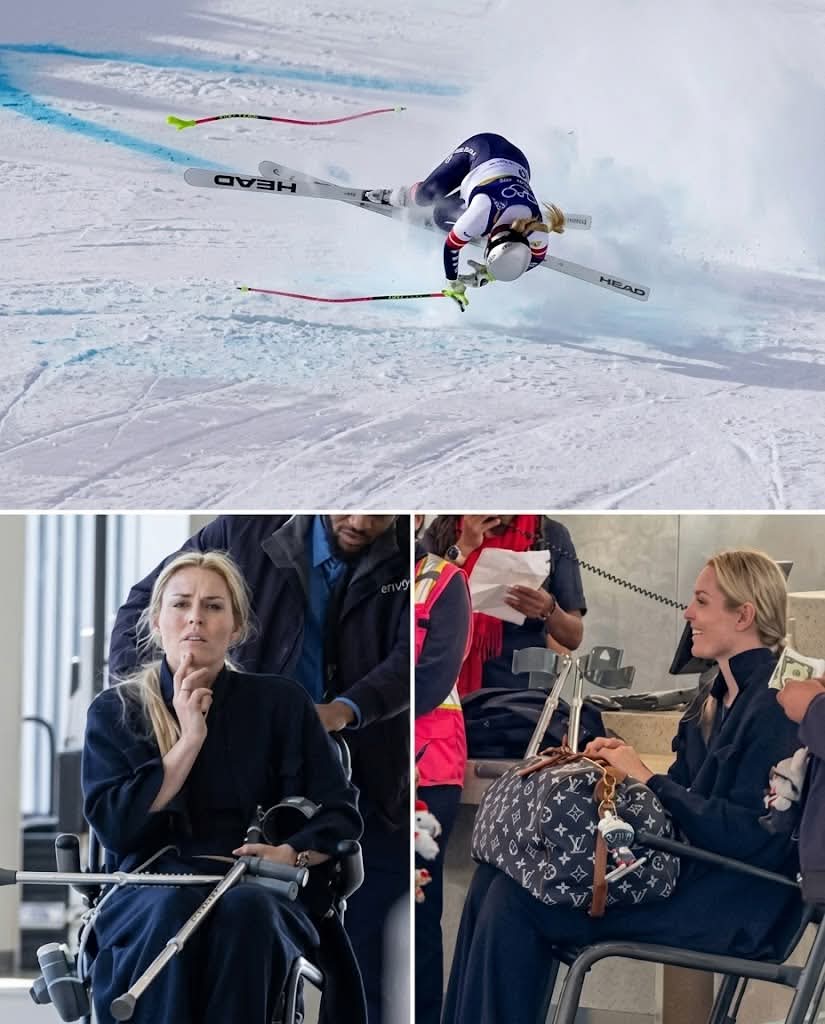
For Lindsey Vonn, the 2026 Winter Olympics in Milano-Cortina were supposed to be the ultimate coda to a legendary career. After coming out of retirement following a revolutionary partial knee replacement, the 41-year-old was defying both age and medical expectations. However, a high-speed crash during the downhill event on February 8 transformed a quest for gold into a desperate medical emergency. What followed was not a fight for a podium, but a race against time to prevent the amputation of her left leg.
A Split-Second Catastrophe
The incident occurred just seconds into Vonn’s run. While navigating the treacherous terrain of Cortina, she struck a gate, resulting in a violent tumble that left her with a complex tibia fracture, a fractured fibula head, and a shattered tibial plateau. While Vonn has famously played through pain for decades, the severity of this impact was unprecedented. The real danger, however, manifested shortly after she was airlifted from the mountain: Vonn developed acute compartment syndrome. This life-threatening condition occurs when internal pressure builds within muscle groups, cutting off blood flow and oxygen, which can lead to permanent nerve damage or the loss of the limb within hours.
The Six-Hour Miracle
As the medical team in Italy assessed the damage, the situation turned critical. Team USA physician Dr. Tom Hackett performed an emergency six-hour surgery, including a fasciotomy—a procedure where the fascia is cut to relieve the suffocating pressure on the muscles. Vonn later revealed that without this immediate intervention and subsequent blood transfusions, she was at imminent risk of amputation. Over the following weeks, she underwent five separate surgeries across two continents, including the installation of a massive external fixation device to stabilize her shattered bone structure.
A New Definition of Success
The recovery process has shifted Vonn’s focus from world rankings to basic mobility. Now back in the United States and utilizing a wheelchair during her initial rehabilitation, the most decorated female skier in history is documenting a different kind of victory. “Success today has a completely different meaning than it did a few days ago,” she shared with her millions of followers. Her journey is no longer about the 82 World Cup wins she holds, but about the resilience of the human spirit when the “impossible” happens.
Legacy Over Laurels
While the crash likely signals the final chapter of her competitive racing, Vonn’s impact remains indomitable. By returning to the gym just 25 days after the accident, she continues to serve as a beacon for sports psychology and orthopedic advancement. Her battle is now for a quality of life that allows her to remain active—a fight that she views as bigger than any crystal globe or Olympic medal. Lindsey Vonn has always been a racer; now, she is racing toward a future defined by health rather than speed.