
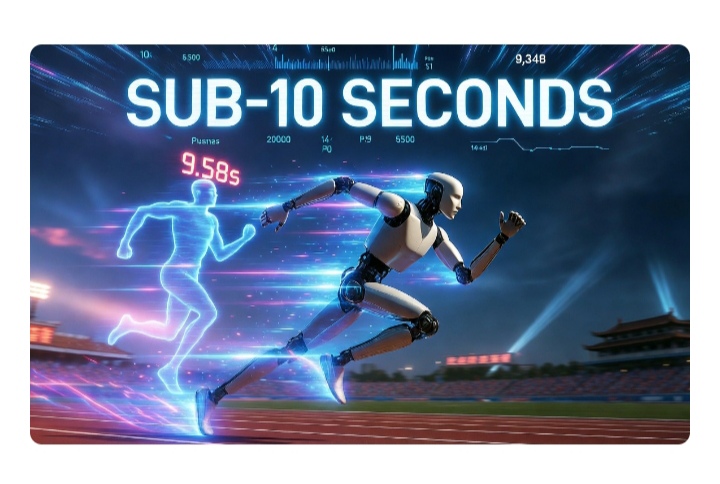
The long-standing boundary between biological peak performance and mechanical engineering is about to dissolve. In a bold declaration that has sent ripples through both the tech and athletic communities, Unitree Robotics CEO Wang Xingxing has predicted that humanoid robots will surpass Usain Bolt’s 100-meter world record of 9.58 seconds before the end of this year. Speaking at the Yabuli China Entrepreneurs Forum in mid-March 2026, Wang asserted that the “revolutionary moment” for robotic locomotion is imminent, with machines expected to break the sub-10-second barrier by this summer.
The Rise of the Mechanical Sprinter

Wang’s forecast is not merely aspirational; it is grounded in a rapidly accelerating arms race within the Chinese robotics sector. Just weeks before his speech, researchers from Zhejiang University, in collaboration with startups MirrorMe (JingShi Technology) and Kaierda, unveiled a full-size humanoid aptly named “Bolt.” Standing 175 centimeters tall and weighing 75 kilograms, this metallic athlete has already clocked a peak running speed of 10 meters per second (36 km/h) in real-world testing.
While Usain Bolt’s legendary 2009 Berlin run averaged 10.44 m/s—with a top speed nearing 12 m/s—the gap is closing at an exponential rate. Current prototypes like “Bolt” are already faster than the vast majority of human sprinters, and with the integration of more powerful actuators and advanced AI-driven gait algorithms, the 9.58-second mark is now firmly in the crosshairs of developers.
Breaking the Intelligence Bottleneck
According to Wang, the transition from clunky, lab-bound movements to world-record velocity is being driven by three critical factors: the plummeting cost of core hardware components, the maturity of global supply chains, and a leap in “embodied intelligence.” For robots to run at elite speeds, they must process environmental data and adjust their balance in microseconds—a feat of real-time computation that was impossible only a few years ago.
The Unitree founder compared this inflection point to the “ChatGPT moment” for physical machines. By using AI to “imagine” and simulate high-quality movement before executing it in the real world, engineers are bypassing years of trial-and-error hardware testing. Unitree itself is leading the charge, with plans to ship up to 20,000 humanoid units in 2026 alone.
A New Era of Athleticism
While the “Bolt” robot and Unitree’s H1 models represent the cutting edge, the implications extend far beyond the track. If a humanoid can navigate a 100-meter sprint at 40 km/h, the same technology will soon be applied to search-and-rescue, industrial inspection, and logistics.
As we approach the mid-year mark, the sporting world watches with bated breath. While a robot’s victory may lack the “blood and tears” of human competition, it marks a definitive milestone in history: the moment the fastest legs on Earth are no longer made of flesh and bone.