
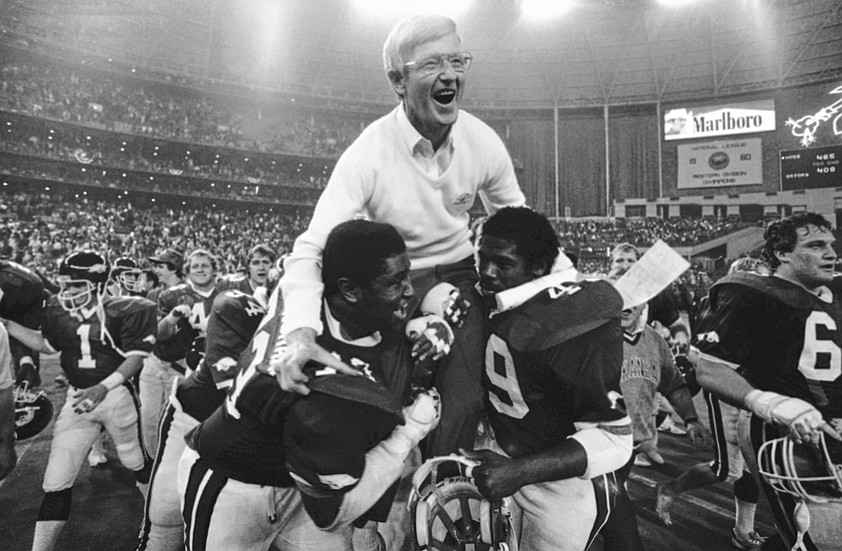
If you were to chronicle the seven-year tenure of Lou Holtz at the University of Arkansas, you might find yourself reaching for the prose of Charles Dickens. It was, quite literally, the best of times and the worst of times. From the peak of national championship contention to the valley of a lackluster departure, the Holtz era remains one of the most polarizing yet statistically impressive chapters in the storied history of Arkansas football.
The Miracle in Miami
The Holtz era began not with a whisper, but with a roar that shook the college football landscape. In his inaugural 1977 season, Holtz orchestrated a campaign that remains legendary in Fayetteville. The Razorbacks marched to an 11-1 record, with their only blemish coming at the hands of a powerhouse Texas team led by the unstoppable Earl Campbell.
However, the season’s crowning achievement was the 1978 Orange Bowl. Entering the game as massive underdogs against a heavily favored Oklahoma squad, Holtz faced a self-imposed crisis after suspending several key players for disciplinary reasons. Against all odds, Arkansas dismantled the Sooners in a 31-6 rout. That night in Miami didn’t just cement a top-ten finish; it signaled that Arkansas had arrived as a perennial national threat under their charismatic new leader.
A Decade of Top-Ten Triumphs
Consistency, for a time, was the hallmark of Holtz’s program. During his seven seasons, the Razorbacks were a fixture in the national conversation, finishing in the top ten of at least one major poll four times. This wasn’t a program that caught lightning in a bottle once; it was a disciplined machine that expected to be in the hunt every November.
Holtz led the Hogs to six bowl games in seven years, a level of post-season regularity that established Arkansas as a Southwest Conference titan. Fans grew accustomed to the sight of Holtz on the sidelines, his quick wit and nervous energy mirroring the high-stakes intensity of the games he coached. Under his watch, the Razorbacks weren’t just participating in big games—they were winning them, maintaining a standard of excellence that felt sustainable.
The Fading Echoes of Greatness
As the 1980s progressed, however, the “best of times” began to yield to a more frustrating reality. The magic that defined the late ’70s started to dissipate, replaced by a sense of stagnation. While the win totals remained respectable, the “it” factor that had nearly carried them to a title in 1977 seemed to have vanished. The high-octane energy was replaced by a grind that left both the coach and the fan base weary.
A Bitter End in Fayetteville
The final chapter of the Holtz era arrived in 1983, and it lacked the cinematic flair of his debut. The Razorbacks finished with a mediocre 6-5 record, a far cry from the double-digit win seasons of the past. Perhaps most telling was the quality of the competition in that final year. The victories—Tulsa, New Mexico, TCU, Houston, Rice, and Texas Tech—lacked the “statement” quality of years prior.
When Holtz resigned following the 1983 season, the departure was tinged with a mix of gratitude for the glory years and relief that the cycle had ended. He left behind a legacy of immense highs and a cautionary tale of how quickly momentum can stall in the unforgiving world of college football.