
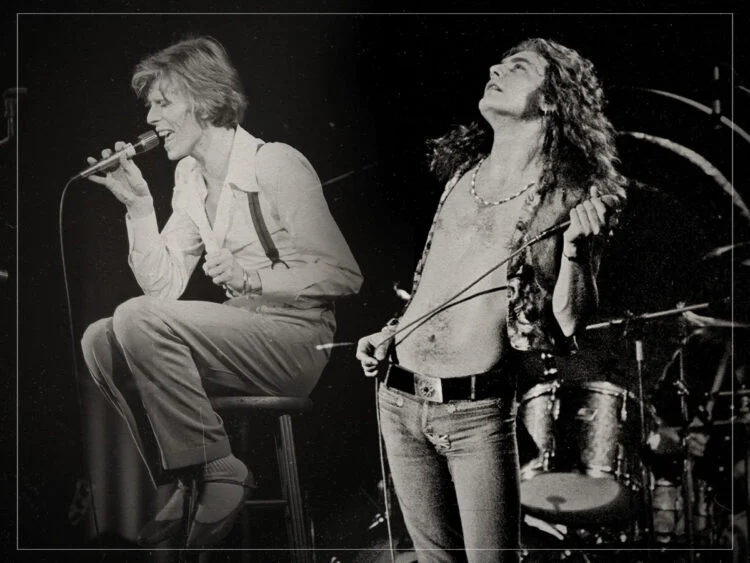
The early 1970s was a period of aesthetic stagnation for rock and roll. To hear David Bowie tell it, the genre had essentially surrendered to a “denim hell.” The fire of the 1960s had been extinguished, replaced by a drab landscape of long hair, beards, and the lingering, dusty beads of the hippie era. “All was rather dull attitudinising,” Bowie recalled in 2003, “with none of the burning ideals of the sixties.”
It was against this backdrop of beige monotony that a new vanguard emerged, trading flared jeans for sequins and gruff sincerity for theatrical artifice. While Bowie’s Ziggy Stardust persona famously led the charge, the movement’s influence bled into every corner of the industry, eventually uniting the “Starman” with Led Zeppelin’s Robert Plant in their shared admiration for the one man who arguably took the genre’s spirit to its absolute limit: Freddie Mercury.
Escaping the Denim Hell
Bowie and his contemporaries identified a void in the cultural lexicon. By opting for glitter, bold colors, and outrageous silhouettes, they transformed styling from a mere fashion choice into a vital artistic tool. This visual language made the expansive, mercurial sounds of glam rock accessible. It wasn’t just about the music; it was about the persona. This shift allowed rock and roll to become ostentatious and androgynous, breaking the “rules” of masculine performance that had dominated the late 60s.
Robert Plant, though more closely associated with the blues-rock thunder of Led Zeppelin, was a significant beneficiary of this cultural shift. While his personal wardrobe was perhaps more muted than Bowie’s lightning-bolt face paint, his stage presence was deeply rooted in that same androgynous charm. Plant’s confidence—his willingness to embrace a sense of “feeling what was right” rather than adhering to rigid genre tropes—echoed the glam rock ethos of self-invention.
The Thoroughbred Performer
Despite his own status as a rock icon, Plant has always been quick to point toward the performers who truly bridged the gap between glam and the operatic. In Plant’s view, there is a rare, “thoroughbred condition” required to be both a virtuoso musician and a confident showman. For him, and for Bowie, that pinnacle was Freddie Mercury.
“There’s so few people behind the glamour who really make it as true performers,” Plant once noted. “It’s a very strange condition to be a successful musician and still be able to project it with confidence. Freddie had that.”
Mercury took the foundation laid by glam—the glitter, the camp, and the subversion of gender—and propelled it into the realm of rock opera. Where others used styling to enhance their music, Mercury used it to command stadiums. He took the spirit of the era “over the edge,” ensuring that when the makeup was eventually stripped away in the late 70s, the “feeling” of the genre remained embedded in rock’s DNA.
A Lasting Legacy
The legacy of this era isn’t found in the remnants of silk scarves or platform boots, but in the freedom it granted future artists. Bowie and Plant understood that rock was not just a sound, but a projection of confidence. By rejecting the “denim hell,” they opened the door for a brand of performance that was as visual as it was auditory—a world where Freddie Mercury could reign supreme as the ultimate “thoroughbred” of the stage.
As we look back on the evolution of rock, the intersection of these three giants—Bowie, Plant, and Mercury—serves as a reminder that the most “glamorous” thing a performer can do is refuse to be dull.