
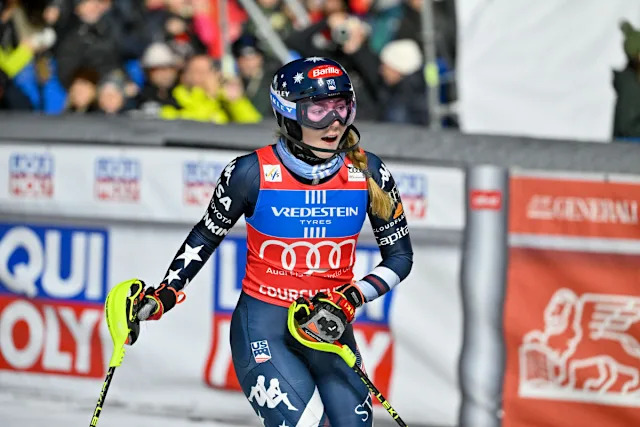
COURCHEVEL, France — In the high-stakes world of alpine skiing, where victory is typically measured in the blink of an eye, Mikaela Shiffrin is currently operating in a different dimension. On December 16, 2025, the American superstar turned the slopes of Courchevel into her personal stage, delivering a performance that didn’t just win a race—it sent a resounding message to the rest of the world.
With her latest triumph in the slalom, Shiffrin secured her fourth consecutive victory of the season in the discipline. If you factor in her win at the tail end of last season, she is currently riding a five-race winning streak in slalom. This latest gold medal extends her historic, record-breaking tally to 105 World Cup victories, with 68 of those coming in her signature slalom event.
Dominance by the Decimal
The sheer scale of Shiffrin’s dominance this season is becoming difficult for statisticians to quantify. In a sport often decided by hundredths of a second—where a gust of wind or a minor edge catch can be the difference between a podium and a heartbreak—Shiffrin is winning by canyon-sized margins.
In Courchevel, she finished a staggering 1.55 seconds ahead of second-place finisher Camille Rast of Switzerland. This wasn’t an anomaly; it’s a trend. Across her four wins this season, her margins have been:
* 1.66 seconds in Levi, Finland
* 1.23 seconds in Gurgl, Austria
* 1.57 seconds in Copper Mountain, Colorado
* 1.55 seconds in Courchevel, France
With an average winning margin of 1.5025 seconds, Shiffrin is effectively removing the element of chance from the equation. She isn’t just beating the field; she is outclassing it.
Resilience After the “DNF”
The victory in France was particularly sweet given the minor setback Shiffrin faced earlier in the week. Competing in the Super-G at St. Moritz—her first foray into the speed discipline since 2023—she recorded a DNF (Did Not Finish). For many athletes, such a result might sow seeds of doubt. For Shiffrin, it served as a reset button.
During Run 1 in Courchevel, she was untouchable, clocking the fastest splits in every single segment of the course. While Camille Rast (+1.55) and Germany’s Emma Aicher (+1.71) rounded out the podium with impressive performances, they were essentially racing for second place. The American success story continued just off the podium as well, with Paula Moltzan finishing fourth (+1.82), a result that propelled her to fifth in the overall world rankings.
The Road to Milan Cortina 2026
As the calendar turns toward 2026, the sporting world is shifting its focus toward the Milan Cortina Winter Olympics, now less than two months away. For Shiffrin, the upcoming Games represent more than just another opportunity for hardware; they represent a shot at redemption.
The 2022 Beijing Winter Games were a rare low point in an otherwise stellar career, as Shiffrin competed in seven events without securing a medal. However, the 2025 version of Shiffrin appears more focused and calculated than ever. She has already signaled a strategic shift for the upcoming Olympics, opting to focus on her core strengths: the slalom, the giant slalom, and the team combined.
By narrowing her scope and leaning into the “technical” disciplines where she currently holds a statistical stranglehold, Shiffrin is positioning herself to be the undisputed face of the 2026 Games. If her performance in Courchevel is any indication, the “Redemption Tour” is already well underway.